


Heart failure (HF) is a highly prevalent condition, particularly among the elderly, and is associated with high rates of readmission and mortality. To improve prognosis, risk assessment tools such as ELAN-HF and BCN-Bio-HF have been developed to estimate mortality after a hospitalization for HF. However, in clinical practice, risk evaluation is often based on the physician's subjective perception. This study aims to compare that perception with the mortality predictions generated by these tools.
MethodsA retrospective, observational study was conducted in a secondary-level hospital between 2019 and 2021, including patients recently discharged after hospitalization for HF. At the first follow-up visit, physicians subjectively classified the patients' risk into three levels without access to the results of the risk scores. Afterwards, the ELAN-HF and BCN-Bio-HF scores were calculated and compared with clinical outcomes at 12 months. The predictive capacity of each method was evaluated.
ResultsA total of 125 patients were included (median age: 76 years [71,5-83], 56% male). The overall mortality rate was 34.4%. The ELAN-HF and BCN-Bio-HF scores better identified high-risk patients than the clinical assessment, which underestimated mortality in the low-risk group. ROC curve analysis showed good predictive ability for mortality, particularly for the BCN-Bio-HF score (AUC: 74.6%).
ConclusionsThe results support that risk scores are more accurate than physicians’ subjective evaluation in predicting mortality in patients with HF. Their integration into clinical practice is recommended, given their prognostic value and usefulness in patient follow-up.
La insuficiencia cardiaca (IC) es una condición muy prevalente, especialmente entre las personas mayores, con altas tasas de reingreso y mortalidad. Para mejorar el pronóstico se han desarrollado escalas de riesgo como la ELAN-HF y la BCN-Bio-HF, que estiman la mortalidad tras un ingreso por IC. Sin embargo, en la práctica clínica la valoración suele basarse en la percepción subjetiva del médico. Este estudio tiene como objetivo comparar dicha percepción con las predicciones obtenidas mediante estas escalas.
MétodosSe realizó un estudio observacional, retrospectivo, en un hospital de segundo nivel entre 2019 y 2021, incluyendo pacientes dados de alta recientemente por IC. En la primera consulta los médicos clasificaron el riesgo en tres niveles sin conocer los resultados de las escalas. Posteriormente, se calcularon los valores de ELAN-HF y BCN-Bio-HF, y se compararon con los desenlaces clínicos a 12 meses. Se evaluó la capacidad predictiva de cada método.
ResultadosSe incluyeron 125 pacientes (mediana de edad: 76 [71,5-83], 56% hombres). La mortalidad fue del 34,4%. Las escalas ELAN-HF y BCN-Bio-HF identificaron mejor a los pacientes de alto riesgo que la valoración clínica, que subestimó la mortalidad en el grupo clasificado como de bajo riesgo. Las curvas ROC mostraron una buena capacidad predictiva de mortalidad, especialmente la de la escala BCN-Bio-HF (AUC: 74,6%).
ConclusionesLos resultados apoyan que las escalas de riesgo son más precisas que la evaluación subjetiva del médico para predecir mortalidad en pacientes con IC. Se recomienda su integración en la práctica clínica, dado su valor pronóstico y utilidad en el seguimiento de estos pacientes.
Article
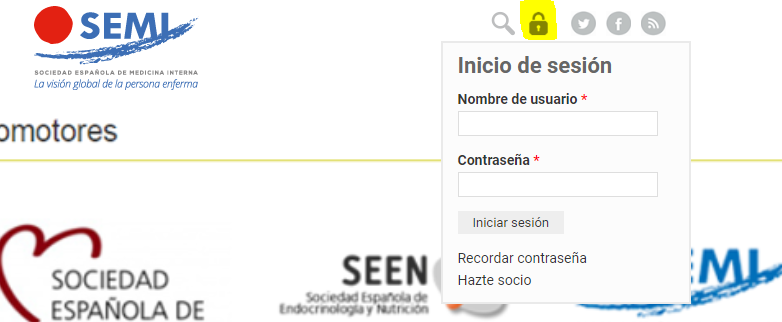
Diríjase desde aquí a la web de la >>>FESEMI<<< e inicie sesión mediante el formulario que se encuentra en la barra superior, pulsando sobre el candado.
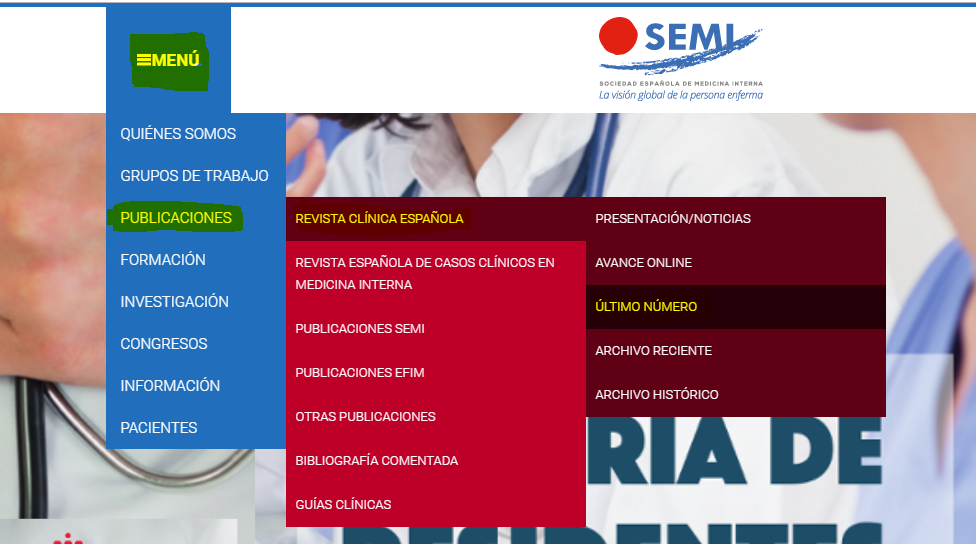
Una vez autentificado, en la misma web de FESEMI, en el menú superior, elija la opción deseada.
>>>FESEMI<<<