Sugerencias
Idioma
Guía para autores
Buscador
Información de la revista
Cita
Cita
Compartir
Descargar PDF
Más opciones de artículo
Visitas
868
Revisión

Precisión diagnóstica del NT-proBNP sérico en derrames pleurales por insuficiencia cardiaca: una revisión sistemática y metaanálisis actualizado

Diagnostic accuracy of serum NT-proBNP for pleural effusions due to congestive heart failure: a systematic review and updated meta-analysis
Visitas
868
Jian-Ying Cuia,b, Wen-Qi Zhengb,c, José M. Porceld, Zhi-De Hub,c,e,f, Yan Niug, Li Yana,b,
Autor para correspondencia
yanli20111008@163.com

Autor para correspondencia.
a Departamento de Medicina Respiratoria y Cuidados Intensivos, Hospital Afiliado de la Universidad Médica de Mongolia Interior, Hohhot 010010, China
b Laboratorio Clave de Biomarcadores, Universidad Médica de Mongolia Interior, Hohhot 010010, China
c Departamento de Medicina de Laboratorio, Hospital Afiliado de la Universidad Médica de Mongolia Interior, Hohhot 010010, China
d Unidad de Medicina Pleural y Ultrasonido Clínico, Departamento de Medicina Interna, Hospital Universitario Arnau de Vilanova, IRBLleida, Universidad de Lleida, Lleida, España
e Centro de Investigación en Epidemiología Clínica, Hospital Afiliado de la Universidad Médica de Mongolia Interior, Hohhot 010010, China
f Laboratorio Clave de Mongolia Interior para la Patogénesis y el Diagnóstico de Enfermedades Reumáticas y Autoinmunes, Hohhot 010010, China
g Centro de Servicio Público para la Investigación Médica, Universidad Médica de Mongolia Interior, Hohhot 010010, China
Este artículo ha recibido
Información del artículo
Resumen
Texto completo
Bibliografía
Descargar PDF
Estadísticas
Resumen
Antecedentes y objetivo

Varios estudios han investigado el valor diagnóstico de la fracción aminoterminal del péptido natriurético cerebral (NT-proBNP) en suero para la insuficiencia cardiaca congestiva (ICC) en pacientes con derrame pleural de etiología no filiada, pero los resultados son inconsistentes. Esta revisión sistemática tuvo como objetivo determinar la precisión diagnóstica de los niveles séricos de NT-proBNP en los derrames pleurales relacionados con la ICC.

Métodos

Se realizaron búsquedas en las bases de datos PubMed y Web of Science para identificar estudios elegibles que evaluaran la precisión del NT-proBNP sérico en el diagnóstico de derrames pleurales relacionados con la ICC hasta el 1 de marzo de 2025. Se utilizó un modelo bivariante para resumir la sensibilidad y especificidad combinadas. La precisión diagnóstica global se evaluó mediante una curva resumen de características operativas del receptor (sROC). En los estudios que evaluaron ambas determinaciones, se comparó la precisión del NT-proBNP en suero y líquido pleural. La calidad metodológica de los estudios se evaluó mediante la versión revisada de la herramienta Quality Assessment of Diagnostic Accuracy Studies (QUADAS-2).

Resultados

Se incluyeron siete estudios, que comprendieron 1.098 pacientes con derrame pleural relacionado con ICC y 1.114 sin ICC. La sensibilidad y especificidad combinadas del NT-proBNP sérico para el diagnóstico de derrame pleural por ICC fueron del 0,83 (IC 95%: 0,75–0,88) y del 0,84 (IC 95%: 0,75–0,91), respectivamente. El cociente de probabilidad positivo fue de 5,3 (IC 95%: 3,2–8,8), el cociente de probabilidad negativo de 0,20 (IC 95%: 0,14–0,31), la Odds Ratio diagnóstica de 26 (IC 95%: 12–56) y el área bajo la curva (AUC) sROC de 0,90 (IC 95%: 0,87–0,92). No se detectó sesgo de publicación. La comparación directa de cinco estudios mostró que el AUC del NT-proBNP sérico y pleural para identificar ICC fue similar.

Conclusiones

El nivel sérico de NT-proBNP muestra una buena precisión diagnóstica para los derrames pleurales relacionados con la ICC, comparable a la del NT-proBNP en líquido pleural.

Palabras clave:
Derrame pleural
Péptido natriurético cerebral N-terminal sérico
Insuficiencia cardiaca
Metaanálisis
Sensibilidad
Especificidad
Abreviaturas:
ACC
A
AUC
BTS
ICC
IC
DOR
ECLIA
ELISA
ESC
FN
FP
HFSA
CH
DPM
NLR
VPN
NI
SN
NT-proBNP
EP
LP
PLR
DPP
VPP
QUADAS-2
sROC
VN
VP
DPT
Abstract
Background and Objective

Several studies have investigated the diagnostic value of serum N-terminal pro-brain natriuretic peptide (NT-proBNP) for congestive heart failure (CHF) in patients with undiagnosed pleural effusion, but results remain inconsistent. This systematic review aimed to determine the diagnostic accuracy of serum NT-proBNP levels in CHF-related effusions.

Methods

PubMed and Web of Science databases were searched for eligible studies investigating the accuracy of serum NT-proBNP in diagnosing CHF-related pleural effusions until March 1, 2025. We used a bivariate model to summarize the pooled sensitivity and specificity. The overall diagnostic accuracy was evaluated using a summary receiver operating characteristic (sROC) curve. We compared the accuracy of serum and pleural fluid NT-proBNP levels in studies evaluating both. Study quality was assessed using the revised Quality Assessment of Diagnostic Accuracy Studies (QUADAS-2).

Results

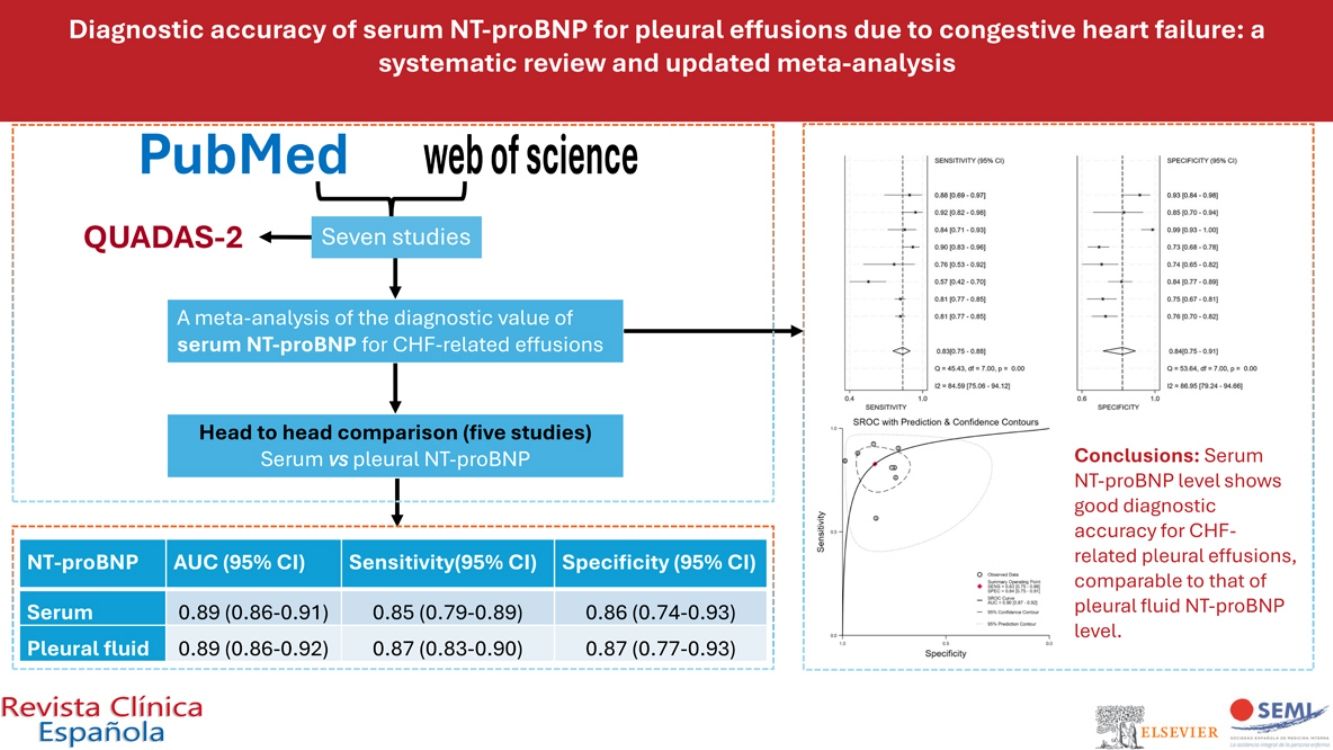
Seven studies, including 1098 patients with and 1114 without CHF-related pleural effusion, were included. Serum NT-proBNP's pooled sensitivity and specificity for diagnosing CHF-related pleural effusion were 0.83 (95% CI: 0.75–0.88) and 0.84 (95% CI: 0.75–0.91). The positive likelihood ratio was 5.3 (95% CI: 3.2–8.8), negative likelihood ratio 0.20 (95% CI: 0.14–0.31), diagnostic odds ratio 26 (95% CI: 12–56), and area under the sROC curve 0.90 (95% CI: 0.87–0.92). No publication bias was detected. A head-to-head comparison of five studies showed that the area under the curve (AUC) of serum and pleural NT-proBNP for labeling CHF was similar.

Conclusions

Serum NT-proBNP level shows good diagnostic accuracy for CHF-related pleural effusions, with diagnostic performance comparable to that of pleural fluid NT-proBNP level.
Keywords:
Pleural effusion
N-terminal pro-brain natriuretic peptide
Heart failure
Meta-analysis
Sensitivity
Specificity
Resumen gráfico

Artículo

Opciones para acceder a los textos completos de la publicación Revista Clínica Española
Socio
Si es usted socio de FESEMI siga los siguientes pasos:

Diríjase desde aquí a la web de la >>>https://www.fesemi.org/publicaciones/revista-clinica/noticias<<< e inicie sesión mediante el formulario que se encuentra en la barra superior, pulsando sobre el candado.

Deslice el cursor hacia abajo hasta la sección "PUBLICACIONES" y pinche en "Revista Clínica Española":

>>>https://www.fesemi.org/publicaciones/revista-clinica/noticias<<<


Suscriptor
Suscriptor de la revista

Si ya tiene sus datos de acceso, clique aquí.

Si olvidó su clave de acceso puede recuperarla clicando aquí y seleccionando la opción "He olvidado mi contraseña".
Suscribirse
Suscribirse a:
Revista Clínica Española
Comprar
Comprar acceso al artículo

Comprando el artículo el PDF del mismo podrá ser descargado

Comprar ahora
Contactar
Teléfono para suscripciones e incidencias
De lunes a viernes de 9h a 18h (GMT+1) excepto los meses de julio y agosto que será de 9 a 15h
Llamadas desde España
932 415 960
Llamadas desde fuera de España
+34 932 415 960
Email
Bibliografía
[1]
B. Jany, T. Welte.
Pleural Effusion in Adults-Etiology Diagnosis, and Treatment.
Dtsch Arztebl Int., 116 (2019), pp. 377-386
[2]
D. Feller-Kopman, R. Light.
Pleural Disease.
N Engl J Med., 378 (2018), pp. 740-751
[3]
R.W. Light.
Pleural effusions.
Med Clin North Am., 95 (2011), pp. 1055-1070
[4]
P. Tian, R. Qiu, M. Wang, et al.
Prevalence Causes, and Health Care Burden of Pleural Effusions Among Hospitalized Adults in China.
[5]
A. Chopra, K. Hu, D.E. Gemoets, M.A. Judson.
The Impact of Clinically Significant Pleural Effusion on Survival of US Veterans With Cancer Congestive Heart Failure, and Pneumonia: The Veterans Administration Lung Effusion Study.
[6]
T. Wijayaratne, A. Yousuf, R. Panchal.
Cardiac related pleural effusions: a narrative review.
J Thorac Dis., 16 (2024), pp. 1674-1686
[7]
V. Madhok, G. Falk, A. Rogers, A.D. Struthers, F.M. Sullivan, T. Fahey.
The accuracy of symptoms, signs and diagnostic tests in the diagnosis of left ventricular dysfunction in primary care: a diagnostic accuracy systematic review.
BMC Fam Pract., 9 (2008), pp. 56
[8]
D.A. Morrow, J.A. de Lemos.
Benchmarks for the assessment of novel cardiovascular biomarkers.
Circulation., 115 (2007), pp. 949-952
[9]
J.L. Januzzi Jr., A.A. Chen-Tournoux, R.H. Christenson, et al.
N-Terminal Pro-B-Type Natriuretic Peptide in the Emergency Department: The ICON-RELOADED Study.
J Am Coll Cardiol., 71 (2018), pp. 1191-1200
[10]
A. Worster, C.M. Balion, S.A. Hill, et al.
Diagnostic accuracy of BNP and NT-proBNP in patients presenting to acute care settings with dyspnea: a systematic review.
Clin Biochem., 41 (2008), pp. 250-259
[11]
C.W. Yancy, M. Jessup, B. Bozkurt, et al.
2017 ACC/AHA/HFSA Focused Update of the 2013 ACCF/AHA Guideline for the Management of Heart Failure: A Report of the American College of Cardiology/American Heart Association Task Force on Clinical Practice Guidelines and the Heart Failure Society of America.
J Am Coll Cardiol., 70 (2017), pp. 776-803
[12]
P. Ponikowski, A.A. Voors, S.D. Anker, et al.
2016 ESC Guidelines for the Diagnosis and Treatment of Acute and Chronic Heart Failure.
Rev Esp Cardiol (Engl Ed)., 69 (2016),
[13]
M.D.F. McInnes, D. Moher, B.D. Thombs, et al.
Preferred Reporting Items for a Systematic Review and Meta-analysis of Diagnostic Test Accuracy Studies: The PRISMA-DTA Statement.
JAMA., 319 (2018), pp. 388-396
[14]
X.S. Cao, C.M. Feng, L. Yan, et al.
Diagnostic accuracy of pleural fluid carbohydrate antigen 72-4 for malignant pleural effusion: a systematic review and meta-analysis.
Transl Cancer Res., 14 (2025), pp. 1237-1245
[15]
P.F. Whiting, A.W. Rutjes, M.E. Westwood, et al.
QUADAS-2: a revised tool for the quality assessment of diagnostic accuracy studies.
Ann Intern Med., 155 (2011), pp. 529-536
[16]
J.B. Reitsma, A.S. Glas, A.W. Rutjes, R.J. Scholten, P.M. Bossuyt, A.H. Zwinderman.
Bivariate analysis of sensitivity and specificity produces informative summary measures in diagnostic reviews.
J Clin Epidemiol., 58 (2005), pp. 982-990
[17]
S.D. Walter.
Properties of the summary receiver operating characteristic (SROC) curve for diagnostic test data.
Stat Med., 21 (2002), pp. 1237-1256
[18]
J.P. Higgins, S.G. Thompson, J.J. Deeks, D.G. Altman.
Measuring inconsistency in meta-analyses.
[19]
J. Wang, M. Leeflang.
Recommended software/packages for meta-analysis of diagnostic accuracy.
J Lab Precis Med., 4 (2019), pp. 22
[20]
J.M. Porcel, J. Trujillano, L. Porcel, A. Esquerda, S. Bielsa.
Development and validation of a diagnostic prediction model for heart failure-related pleural effusions: the BANCA score.
[21]
M. Zhang, M.P. Jiang, L. Yan, J.X. Wen, W.Q. Zheng, Z.D. Hu.
Age affects the diagnostic accuracy of serum N-terminal pro-B-type natriuretic peptide for heart failure in patients with pleural effusion.
Clin Biochem., 114 (2023), pp. 52-58
[22]
O.J. Bintcliffe, C.E. Hooper, I.J. Rider, et al.
Unilateral Pleural Effusions with More Than One Apparent Etiology. A Prospective Observational Study.
Ann Am Thorac Soc., 13 (2016), pp. 1050-1056
[23]
L. Valdes, E.S. Jose, A. Pose, et al.
Diagnostic value of N-terminal pro-brain natriuretic peptide in pleural effusions of cardiac origin.
Arch Bronconeumol., 47 (2011), pp. 246-251
[24]
M. Bayram, G. Ozkan, E. Oztekin, et al.
Role of serum and pleural fluid NT-proBNP levels in identifying pleural effusion due to heart failure.
Multidiscip Respir Med., 4 (2009), pp. 175-181
[25]
J.M. Porcel, J. Chorda, G. Cao, A. Esquerda, A. Ruiz-Gonzalez, M. Vives.
Comparing serum and pleural fluid pro-brain natriuretic peptide (NT-proBNP) levels with pleural-to-serum albumin gradient for the identification of cardiac effusions misclassified by Light's criteria.
Respirology., 12 (2007), pp. 654-659
[26]
M. Kolditz, M. Halank, C.S. Schiemanck, A. Schmeisser, G. Höffken.
High diagnostic accuracy of NT-proBNP for cardiac origin of pleural effusions.
Eur Respir J., 28 (2006), pp. 144-150
[27]
K. Linnet, P.M. Bossuyt, K.G. Moons, J.B. Reitsma.
Quantifying the Accuracy of a Diagnostic Test or Marker.
Clin Chem., 58 (2012), pp. 1292-1301
[28]
C. Liu, Y.L. Cui, C.M. Ding, et al.
Diagnostic accuracy of interferon-gamma in pericardial effusions for tuberculous pericarditis: a meta-analysis.
J Thorac Dis., 10 (2018), pp. 854-860
[29]
J.J. Deeks, D.G. Altman.
Diagnostic tests 4: likelihood ratios.
[30]
Z.J. Han, X.D. Wu, J.J. Cheng, et al.
Diagnostic Accuracy of Natriuretic Peptides for Heart Failure in Patients with Pleural Effusion: A Systematic Review and Updated Meta-Analysis.
[31]
Q. Zhou, Z.J. Ye, Y. Su, J.C. Zhang, H.Z. Shi.
Diagnostic value of N-terminal pro-brain natriuretic peptide for pleural effusion due to heart failure: a meta-analysis.
Heart., 96 (2010), pp. 1207-1211
[32]
S. Janda, J. Swiston.
Diagnostic accuracy of pleural fluid NT-pro-BNP for pleural effusions of cardiac origin: a systematic review and meta-analysis.
BMC Pulm Med., 10 (2010), pp. 58
[33]
M.E. Roberts, N.M. Rahman, N.A. Maskell, et al.
British Thoracic Society Guideline for pleural disease.
[34]
J.M. Porcel, M. Martínez-Alonso, G. Cao, S. Bielsa, A. Sopena, A. Esquerda.
Biomarkers of heart failure in pleural fluid.
Chest., 136 (2009), pp. 671-677
[35]
M.M. Leeflang, K.G. Moons, J.B. Reitsma, A.H. Zwinderman.
Bias in sensitivity and specificity caused by data-driven selection of optimal cutoff values: mechanisms, magnitude, and solutions.
Clin Chem., 54 (2008), pp. 729-737
Idiomas
Revista Clínica Española
Opciones de artículo
Herramientas
Material suplementario