Sugerencias
Idioma
Guía para autores
Buscador
Información de la revista
Cita
Cita
Compartir
Descargar PDF
Más opciones de artículo
Visitas
886
Original

El efecto de la edad en la precisión de los criterios de Light

The effect of age on the accuracy of Light's criteria
Visitas
886
W.-Q. Zhenga,b, S. Bielsac, Y. Niud, J.-X. Wend, L. Yanb,e, Z.-D. Hua,b,f,1,
Autor para correspondencia
hzdlj81@163.com
huzd@immu.edu.cn

Autor para correspondencia.
, J.M. Porcelc,1
a Departamento de Medicina de Laboratorio, Hospital Afiliado de la Universidad Médica de Mongolia Interior, Hohhot, China
b Laboratorio principal de biomarcadores, Universidad Médica de Mongolia Interior, Hohhot, China
c Servicio de Medicina Pleural y Ecografía Clínica, Servicio de Medicina Interna, Hospital Universitario Arnau de Vilanova, IRBLleida, Universidad de Lleida, Lleida, España
d Centro de Experimentación Médica, Facultad de Medicina Básica, Universidad Médica de Mongolia Interior, Hohhot, China
e Servicio de Medicina Respiratoria e Intensiva, Hospital Afiliado de la Universidad Médica de Mongolia Interior, Hohhot, China
f Centro de Investigación en Epidemiología Clínica, Hospital Afiliado de la Universidad Médica de Mongolia Interior, Hohhot, China
Este artículo ha recibido
Información del artículo
Resumen
Texto completo
Bibliografía
Descargar PDF
Estadísticas
Resumen
Objetivo

Este estudio propone investigar los efectos de la edad sobre la sensibilidad, la especificidad y la eficacia de los criterios de Light para diferenciar derrames pleurales trasudativos de los exudativos.

Métodos

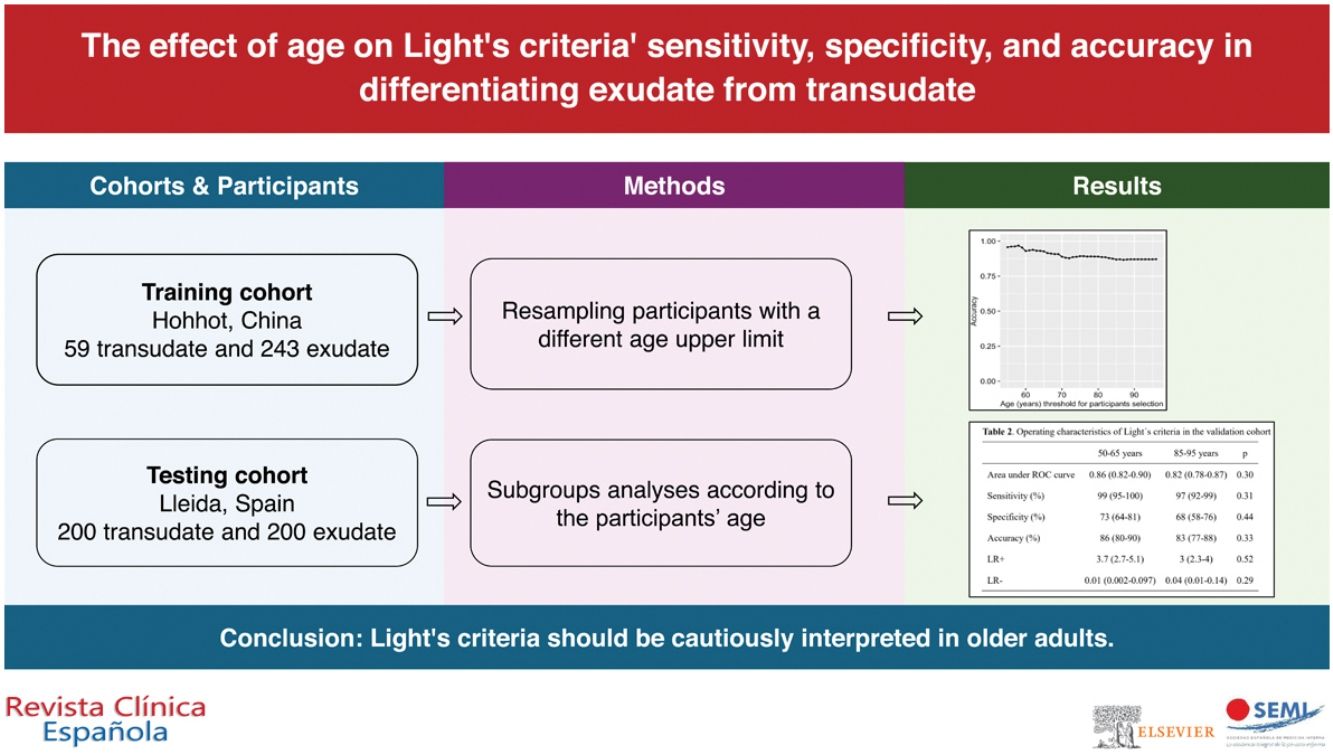
Para el análisis de datos se utilizó una cohorte de derivación de China y una de validación de España. La cohorte de derivación incluyó 302 pacientes (59 trasudados y 243 exudados) con un derrame pleural no diagnosticado. La cohorte de validación comprendió 400 pacientes (200 trasudados y 200 exudados) divididos en dos grupos según la edad (200 pacientes de 50-65años y 200 pacientes de 80-95años). Los efectos de la edad sobre la sensibilidad, la especificidad y la eficacia de los criterios de Light se determinaron muestreando pacientes con diferentes límites de edad.

Resultados

En la cohorte de derivación, la sensibilidad y la especificidad de los criterios de Light fue de 0,91 y 0,73, respectivamente. En la cohorte de validación, la sensibilidad de los criterios de Light fue de 0,99 y 0,97, y la especificidad, de 0,73 y 0,68, por grupos de edad, respectivamente. Las métricas de eficacia diagnóstica (sensibilidad, especificidad, eficacia o valor global) de los criterios de Light y sus componentes tienden a decrecer con la edad.

Conclusión

Se debe considerar la edad cuando se interpretan los criterios de Light.

Palabras clave:
Criterios de Light, Edad, Eficacia, Trasudado, Exudado, Derrame pleural
Abstract
Objective

This study aimed to investigate the effects of age on the sensitivity, specificity, and accuracy of Light's criteria to differentiate exudative from transudative pleural effusion.

Methods

A testing cohort from China and a validation cohort from Spain were used for data analysis. The testing cohort included 302 patients (59 transudates and 243 exudates) with undiagnosed pleural effusion. The validation cohort comprised 400 patients (200 transudates and 200 exudates) divided into two groups according to age (200 patients aged 50-65years and 200 patients aged 80-95years). The effects of age on the sensitivity, specificity, and accuracy of Light's criteria were determined by sampling patients with different age limits.

Results

In the testing cohort, the sensitivity and specificity of Light's criteria for exudate were 0.91 and 0.73, respectively. In the validation cohort, the sensitivity was 0.99 and 0.97, and the specificity of Light's criteria for exudate was 0.73 and 0.68, respectively, by age group. The diagnostic accuracy metrics (sensitivity, specificity, and accuracy) of Light's criteria and its items tended to decrease with age.

Conclusion

Age should be considered when interpreting the Light's criteria.
Keywords:
Light's criteria, Age, Accuracy, Transudate, Exudate, Pleural effusion
Resumen gráfico

Artículo

Opciones para acceder a los textos completos de la publicación Revista Clínica Española
Socio
Si es usted socio de FESEMI siga los siguientes pasos:

Diríjase desde aquí a la web de la >>>https://www.fesemi.org/publicaciones/revista-clinica/noticias<<< e inicie sesión mediante el formulario que se encuentra en la barra superior, pulsando sobre el candado.

Deslice el cursor hacia abajo hasta la sección "PUBLICACIONES" y pinche en "Revista Clínica Española":

>>>https://www.fesemi.org/publicaciones/revista-clinica/noticias<<<


Suscriptor
Suscriptor de la revista

Si ya tiene sus datos de acceso, clique aquí.

Si olvidó su clave de acceso puede recuperarla clicando aquí y seleccionando la opción "He olvidado mi contraseña".
Suscribirse
Suscribirse a:
Revista Clínica Española
Comprar
Comprar acceso al artículo

Comprando el artículo el PDF del mismo podrá ser descargado

Comprar ahora
Contactar
Teléfono para suscripciones e incidencias
De lunes a viernes de 9h a 18h (GMT+1) excepto los meses de julio y agosto que será de 9 a 15h
Llamadas desde España
932 415 960
Llamadas desde fuera de España
+34 932 415 960
Email
Bibliografía
[1]
J.M. Porcel, A. Esquerda, M. Vives, S. Bielsa.
Etiology of pleural effusions: analysis of more than 3,000 consecutive thoracenteses.
Arch Bronconeumol., 50 (2014), pp. 161-165
[2]
P. Tian, R. Qiu, M. Wang, et al.
Prevalence, causes, and health care burden of pleural effusions among hospitalized adults in China.
JAMA Netw Open., 4 (2021), pp. e2120306
[3]
W.Q. Zheng, Z.D. Hu.
Pleural fluid biochemical analysis: the past, present and future.
Clin Chem Lab Med., 61 (2023), pp. 921-934
[4]
J.E. Heffner.
Discriminating between transudates and exudates.
Clin Chest Med., 27 (2006), pp. 241-252
[5]
D. Feller-Kopman, R. Light.
Pleural disease.
N Engl J Med., 378 (2018), pp. 740-751
[6]
M. Aboudara, F. Maldonado.
Update in the management of pleural effusions.
Med Clin North Am., 103 (2019), pp. 475-485
[7]
R.W. Light, M.I. Macgregor, P.C. Luchsinger, W.C. Ball Jr..
Pleural effusions: the diagnostic separation of transudates and exudates.
Ann Intern Med., 77 (1972), pp. 507-513
[8]
J.M. Porcel.
Identifying transudates misclassified by Light's criteria.
Curr Opin Pulm Med., 19 (2013), pp. 362-367
[9]
J.H. Huang, H. Chen, Z.C. Zhang, et al.
Age affects the diagnostic accuracy of the cancer ratio for malignant pleural effusion.
BMC Pulm Med., 23 (2023), pp. 198
[10]
W. Zhao, T.W. Jiang, W.Q. Zheng, Z.D. Hu.
Diagnostic accuracy of adenosine deaminase for tuberculous pleural effusion: age does matter.
Clin Chem Lab Med., 62 (2024), pp. e116-e118
[11]
M. Zhang, M.P. Jiang, L. Yan, J.X. Wen, W.Q. Zheng, Z.D. Hu.
Age affects the diagnostic accuracy of serum N-terminal pro-B-type natriuretic peptide for heart failure in patients with pleural effusion.
Clin Biochem., 114 (2023), pp. 52-58
[12]
Z. Yan, J.X. Wen, H. Wang, et al.
Diagnostic accuracy of pleural fluid lactate dehydrogenase to adenosine deaminase ratio for tuberculous pleural effusion: an analysis of two cohorts.
BMC Pulm Med., 22 (2022), pp. 428
[13]
Y.Q. Han, L. Yan, P. Li, L. Zhang, P.H. Ouyang, Z.D. Hu.
A Study Investigating Markers in PLeural Effusion (SIMPLE): a prospective and double-blind diagnostic study.
[14]
D.N. Yang, Y. Niu, J.X. Wen, et al.
Long-term stability of pleural fluid carcinoembryonic antigen and its effect on the diagnostic accuracy for malignant pleural effusion.
Thorac Cancer., 14 (2023), pp. 2077-2084
[15]
J.M. Porcel, R.W. Light.
Pleural fluid analysis: are light's criteria still relevant after half a century?.
Clin Chest Med., 42 (2021), pp. 599-609
[16]
C. Wong, D.R. Goldstein.
Impact of aging on antigen presentation cell function of dendritic cells.
Curr Opin Immunol., 25 (2013), pp. 535-541
[17]
A.A. Sadighi Akha.
Aging and the immune system: an overview.
J Immunol Methods., 463 (2018), pp. 21-26
[18]
S. Romero, A. Martinez, L. Hernandez, et al.
Light's criteria revisited: consistency and comparison with new proposed alternative criteria for separating pleural transudates from exudates.
Respiration., 67 (2000), pp. 18-23
[19]
A. Esquerda, J. Trujillano, I. Lopez de Ullibarri, S. Bielsa, A.B. Madronero, J.M. Porcel.
Classification tree analysis for the discrimination of pleural exudates and transudates.
Clin Chem Lab Med., 45 (2007), pp. 82-87
[20]
J.M. Porcel, M. Vives, M.C. Vicente de Vera, G. Cao, M. Rubio, M.C. Rivas.
Useful tests on pleural fluid that distinguish transudates from exudates.
Ann Clin Biochem., 38 (2001), pp. 671-675
[21]
S. Kristiansen, L. Friis-Hansen, C.A. Juel Jensen, S. Ingemann Hansen.
Verification study on the NORIP LDH reference intervals with a proposed new upper reference limit.
Scand J Clin Lab Invest., 78 (2018), pp. 421-427
[22]
D. Wang, C. Ma, Y. Zou, et al.
Gender and age-specific reference intervals of common biochemical analytes in Chinese population: derivation using real laboratory data.
J Med Biochem., 39 (2020), pp. 384-391
[23]
Y.C.G. Lee, R.J.O. Davies, R.W. Light.
Diagnosing pleural effusion: moving beyond transudate-exudate separation.
Chest., 131 (2007), pp. 942-943
Idiomas
Revista Clínica Española
Opciones de artículo
Herramientas