Sugerencias
Idioma
Guía para autores
Buscador
Información de la revista
Cita
Cita
Compartir
Descargar PDF
Más opciones de artículo
Visitas
673
Original article

Concordance between an algorithm and clinical diagnosis in the severity of decompensation of chronic diseases in patients in a telemonitoring program

Concordancia entre un algoritmo y el diagnóstico clínico en la gravedad de descompensación de enfermedades crónicas de pacientes en un programa de telemonitorización
Visitas
673
J. Fernández-Riveraa,
Autor para correspondencia
, Y. Marín-Fernándeza, M. Gómez-Hernándeza, J. Ortíz-Romerob, A. Fernández-Moyanoa
a Servicio de Medicina Interna, Hospital San Juan de Dios del Aljarafe, Seville, Spain
b Centro de Salud de Mairena del Aljarafe, Seville, Spain
Este artículo ha recibido
Información del artículo
Resumen
Texto completo
Bibliografía
Descargar PDF
Estadísticas
Abstract
Background

Telemonitoring of biological variables can facilitate the early detection of decompensation in chronic disease. Data processing through digital tools enables the delivery of care via automated decision-support systems, such as diagnostic algorithms or alerts in high-rink situations. These tools may improve health outcomes and optimize healthcare management.

Methods

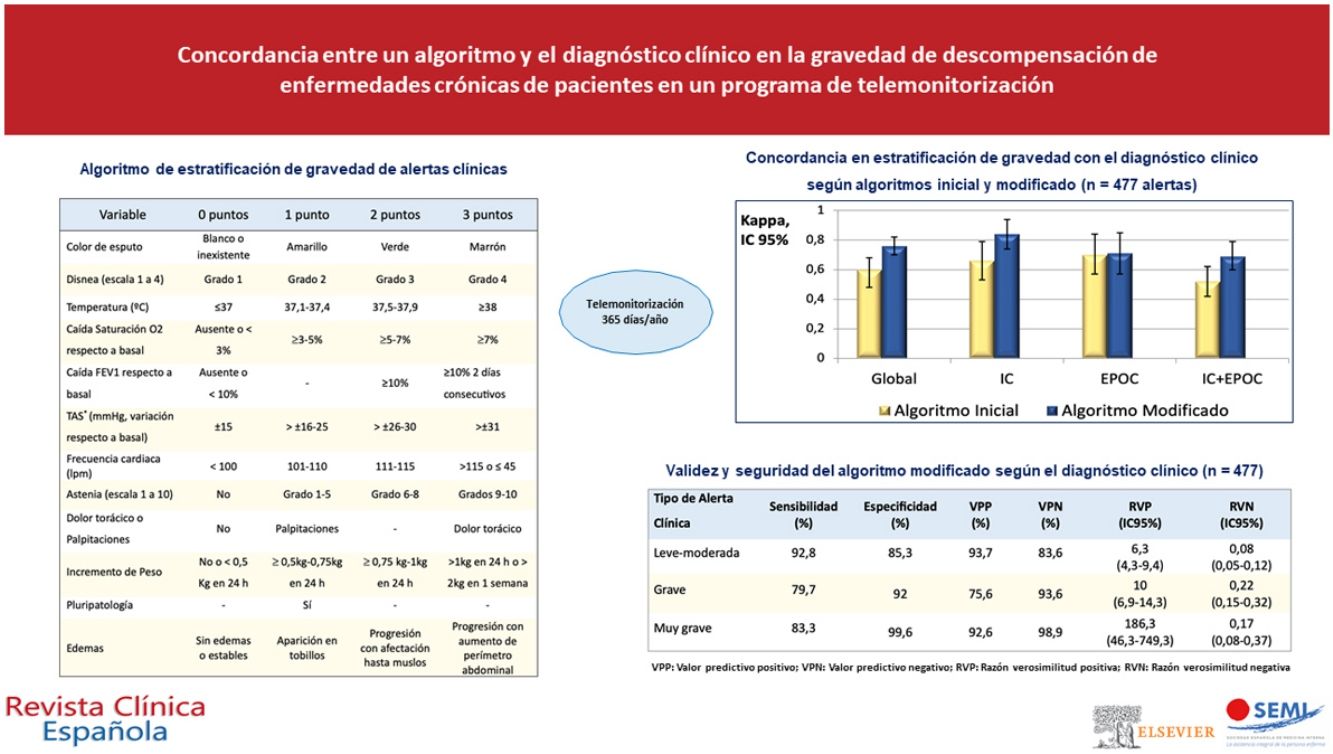
A diagnostic accuracy study with a retrospective cross-sectional design was conducted. Agreement in classifying the severity of decompensation in patients with chronic diseases was compared between the algorithm used in the Tele-COMPARTE program and the consensus of three observers, which was considered the reference standard. The weighted Kappa index was used to assess agreement.

Results

The final version of our algorithm achieved a Kappa index (95% CI) of 0,76 (0,7–0.82). By subgroups, the values were 0,84 (0,74–0,94) for alerts in patients with heart failure, 0,71 (0,57–0,85) in COPD, and 0,69 (0,6–0,79) in alerts involving both conditions, all with P <,001. The positive likelihood ratios were 6,3 in low-level and moderate alerts, 10 for high-level alerts, and 186,3 for critical alerts. Predictive values ​​exceeded 75% in all categories.

Conclusions

The level of agreement between the Tele-COMPARTE algorithm and clinical consensus in stratifying the severity of decompensation in chronic disease was “good”, reaching a “very good” level in patients with heart failure. The application of the algorithm is a valid and safe procedure that supports its use within our remote monitoring program.

Keywords:
Chronic diseases
Telemonitoring
Diagnostic accuracy
Algorithm
Resumen
Introducción

La telemonitorización de variables biológicas puede facilitar la detección precoz de descompensaciones de enfermedades crónicas. El procesamiento de datos mediante herramientas digitales permite ofrecer una atención mediante sistemas automatizados de ayuda en la toma de decisiones como algoritmos diagnósticos o alertas en situaciones de riesgo. Todo ello puede mejorar los resultados en salud y optimizar la gestión sanitaria.

Material y métodos

Se realizó un estudio de precisión diagnóstica con un diseño transversal retrospectivo, comparando el acuerdo al clasificar la gravedad de descompensación de pacientes con enfermedades crónicas entre el algoritmo utilizado en el programa Tele-COMPARTE y el consenso entre tres observadores que se consideró como estándar de referencia. Se utilizó el índice Kappa ponderado.

Resultados

El algoritmo modificado mostró un índice Kappa (IC 95%) de 0,76 (0,7–0,82). Por subgrupos, este valor fue 0,84 (0,74–0,94) en alertas de pacientes con insuficiencia cardiaca, 0,71 (0,57–0,85) en EPOC y 0,69 (0,6–0,79) en alertas de pacientes con ambas patologías, siempre con P <,001. La razón de verosimilitud positiva fue 6,3 en alertas leve-moderadas, 10 en graves y 186,3 en muy graves. Los valores predictivos han resultado > 75% en todos los casos.

Conclusiones

El grado de concordancia al estratificar la gravedad de descompensación de enfermedades crónicas proporcionado por el algoritmo de Tele-COMPARTE y el establecido por el consenso clínico es «bueno», alcanzando el grado «muy bueno» en pacientes con insuficiencia cardiaca. La aplicación del algoritmo es un procedimiento válido y seguro que avala su uso en nuestro programa de telemonitorización.
Palabras clave:
Enfermedades crónicas
Telemonitorización
Precisión diagnóstica
Algoritmo
Resumen gráfico

Artículo

Opciones para acceder a los textos completos de la publicación Revista Clínica Española
Socio
Si es usted socio de FESEMI siga los siguientes pasos:

Diríjase desde aquí a la web de la >>>https://www.fesemi.org/publicaciones/revista-clinica/noticias<<< e inicie sesión mediante el formulario que se encuentra en la barra superior, pulsando sobre el candado.

Deslice el cursor hacia abajo hasta la sección "PUBLICACIONES" y pinche en "Revista Clínica Española":

>>>https://www.fesemi.org/publicaciones/revista-clinica/noticias<<<


Suscriptor
Suscriptor de la revista

Si ya tiene sus datos de acceso, clique aquí.

Si olvidó su clave de acceso puede recuperarla clicando aquí y seleccionando la opción "He olvidado mi contraseña".
Suscribirse
Suscribirse a:
Revista Clínica Española
Comprar
Comprar acceso al artículo

Comprando el artículo el PDF del mismo podrá ser descargado

Comprar ahora
Contactar
Teléfono para suscripciones e incidencias
De lunes a viernes de 9h a 18h (GMT+1) excepto los meses de julio y agosto que será de 9 a 15h
Llamadas desde España
932 415 960
Llamadas desde fuera de España
+34 932 415 960
Email
References
[1]
M. Bernabeu-Wittel, L. Romero, J. Zaragoza, et al.
Characterization of patients with chronic diseases and complex care needs: a new high-risk emergent population.
J Biomed Res Environ Sci, 3 (2022), pp. 1321-1336
[2]
A. Fernández-Moyano, J.M. Machín, M.D. Martín, M.B. Aller, I. Vallejo.
Modelos de atención al paciente pluripatológico.
Rev Clín Esp., 217 (2017), pp. 351-358
[3]
Global strategy on digital health 2020-2025.
[4]
R.V. Tuckson, M. Edmunds, M.L. Hodgkins.
Telehealth.
N Engl J Med, 377 (2017), pp. 1585-1592
[5]
C. Kuziemsky, A.J. Maeder, O. John, et al.
Role of artificial intelligence within the telehealth domain: official 2019 yearbook contribution by the members of IMIA Telehealth Working Group.
Yearb Med Inform, 28 (2019), pp. 035-040
[6]
I. Planinc, D. Milicic, M. Cikes.
Telemonitoring in heart failure management.
Card Fail Rev, 6 (2020), pp. e06
[7]
L. Cristina, E. Geraldo, L. Carvalho, et al.
Telehealth and telemedicine in the management of adult patients after hospitalization for COPD exacerbation: a scoping review.
J Bras Pneumol, 49 (2023),
[8]
D.G. Leo, B.J.R. Buckley, M. Chowdhury, et al.
Interactive remote patient monitoring devices for managing chronic health conditions: systematic review and meta-analysis.
J Med Internet Res, 24 (2022),
[9]
A.A. Lewinski, C. Walsh, S. Rushton, et al.
Telehealth for the longitudinal management of chronic conditions: systematic review.
J Med Internet Res, 24 (2022),
[10]
S.L. Auener, T.E.P. Remers, S.A. van Dulmen, G.P. Westert, R.B. Kool, P.P.T. Jeurissen.
The effect of noninvasive telemonitoring for chronic heart failure on health care utilization: systematic review.
J Med Internet Res, 23 (2021),
[11]
P. Thokala, H. Baalbaki, A. Brennan, et al.
Telemonitoring after discharge from hospital with heart failure: cost-effectiveness modelling of alternative service designs.
BMJ Open, 3 (2013),
[12]
J. Comín-Colet, C. Enjuanes, J.M. Verdú-Rotellar, et al.
Impact on clinical events and healthcare costs of adding telemedicine to multidisciplinary disease management programmes for heart failure: results of a randomized controlled trial.
J Telemed Telecare, 22 (2016), pp. 282-295
[13]
C. Pedone, D. Chiurco, S. Scarlata, R.A. Incalzi.
Efficacy of multiparametric telemonitoring on respiratory outcomes in elderly people with COPD: a randomized controlled trial.
BMC Health Serv Res, 13 (2013), pp. 82
[14]
S. Saha, H. Ross, P.E. Velmovitsky, et al.
Machine learning enhanced expert system for detecting heart failure decompensation using patient reported vitals and electronic health records.
Sci Rep, 15 (2025),
[15]
S. Swaminathan, K. Qirko, T. Smith, et al.
A machine learning approach to triaging patients with chronic obstructive pulmonary disease.
PLoS ONE, 12 (2017),
[16]
A. Fernández-Moyano, J.L. García-Garmendia, C. Palmero, et al.
Continuidad asistencial. Evaluación de un programa de colaboración entre Atención Hospitalaria y Atención Primaria.
Rev Clín Esp, 207 (2007), pp. 510-520
[17]
A. Mortara, G.D. Pinna, P. Johnson, et al.
Home telemonitoring in Heart Failure patients: the HHH study (Home or Hospital in Heart Failure).
Eur J Heart Fail, 11 (2009), pp. 312-318
[18]
F. Koehler, K. Koehler, O. Deckwart, et al.
Efficacy of telemedical interventional management in patients with heart failure (TIM-HF2): a randomised, controlled, parallel-group, unmasked trial.
Lancet, 392 (2018), pp. 1047-1057
[19]
J.B. Soriano, F. García-Río, E. Vázquez-Espinosa, et al.
A multicentre, randomized controlled trial of telehealth for the management of COPD.
Respir Med, 144 (2018), pp. 74-81
[20]
G.A. Hamad, M. Crooks, A.H. Morice.
The value of telehealth in the early detection of chronic obstructive pulmonary disease exacerbations: a prospective observational study.
Health Informatics J, 22 (2016), pp. 406-413
[21]
M.S. Mohktar, S.J. Redmond, N.C. Antoniades, et al.
Predicting the risk of exacerbation in patients with chronic obstructive pulmonary disease using home telehealth measurement data.
Artif Intell Med, 63 (2015), pp. 51-59
[22]
C. Esteban, J. Moraza, M. Iriberri, et al.
Outcomes of a telemonitoring-based program (telEPOC) in frequently hospitalized COPD patients.
COPD, 11 (2016), pp. 2919-2930
[23]
O. Dar, J. Riley, C. Chapman, et al.
A randomized trial of home telemonitoring in a typical elderly heart failure population in North West London: results of the Home‐HF study.
Eur J Heart Fail, 11 (2009), pp. 319-325
[24]
G. Giamouzis, D. Mastrogiannis, K. Koutrakis, et al.
Telemonitoring in chronic heart failure: a systematic review.
Cardiol Res Pract, 2012 (2012), pp. 1-7
[25]
J.R. Landis, G.G. Koch.
The measurement of observer agreement for categorical data.
Biometrics, 33 (1977), pp. 159
[26]
R Core Team. R: Un lenguaje y entorno para la informática estadística. Fundación R para Computación Estadística, 2023, Viena, Austria. Available from: https://www.R-project.org/.
[27]
M.E. Reichenheim.
Confidence intervals for the Kappa statistic.
Stata J, 4 (2004), pp. 421-428
[28]
P.M. Bossuyt, J.B. Reitsma, D.E. Bruns, et al.
STARD 2015: an updated list of essential items for reporting diagnostic accuracy studies.
BMJ, 351 (2015),
[29]
J.A. Knottnerus, F. Buntinx.
The evidence base of clinical diagnosis: Theory and methods of diagnostic research.
BMJ Books, (2002), pp. 226
[30]
K.G.M. Moons, D.G. Altman, J.B. Reitsma, et al.
Transparent reporting of a multivariable prediction model for individual prognosis or diagnosis (TRIPOD): explanation and elaboration.
Ann Intern Med, 162 (2015), pp. W1-73
[31]
H. Ding, R. Jayasena, S.H. Chen, et al.
The effects of telemonitoring on patient compliance with self-management recommendations and outcomes of the innovative telemonitoring enhanced care program for chronic heart failure: randomized controlled trial.
J Med Internet Res, 22 (2020),
[32]
S.C. Inglis, R.A. Clark, R. Dierckx, D. Prieto-Merino, J.G. Cleland.
Structured telephone support or non-invasive telemonitoring for patients with heart failure.
Cochrane Database Syst Rev, 2015 (2015),
[33]
F. Hofer, J. Schreyögg, T. Stargardt.
Effectiveness of a home telemonitoring program for patients with chronic obstructive pulmonary disease in Germany: evidence from the first three years.
PLoS ONE, 17 (2022),
[34]
R. Herold, W. Hoffmann, N. Van Den Berg.
Telemedical monitoring of patients with chronic heart failure has a positive effect on total health costs.
BMC Health Serv Res, 18 (2018), pp. 271
[35]
G. Castelyn, L. Laranjo, G. Schreier, B. Gallego.
Predictive performance and impact of algorithms in remote monitoring of chronic conditions: a systematic review and meta-analysis.
Int J Med Inform, 156 (2021),
Idiomas
Revista Clínica Española
Opciones de artículo
Herramientas
Material suplementario