

Suggestions
Idioma
Guide for authors
Searcher
Journal Information
Cite
Cite
Share
Download PDF
More article options
Visits
803
Original article

Identifying dynapenia using ventilatory parameters in patients with heart failure with preserved ejection fraction: cross-sectional analysis of the FUNNEL+ study

Identificación de la dinapenia mediante parámetros ventilatorios en pacientes con insuficiencia cardíaca con fracción de eyección preservada: análisis transversal del estudio FUNNEL+
Visits
803
C. García-Conejoa,b, C. Roldán-Jiméneza,b, M.A. Pérez-Velascob,c, R. Gómez-Huelgasb,c,d, L.M. Pérez-Belmonteb,c,e,f, A.I. Cuesta-Vargasa,b,
Corresponding author
acuesta@uma.es

Corresponding author.
a Grupo de Investigación Clinimetría CTS-631, Departamento de Fisioterapia, Facultad de Ciencias de la Salud, Universidad de Málaga, Málaga, Spain
b Instituto de Investigación Biomédica de Málaga (IBIMA Plataforma Bionand), Málaga, Spain
c Departamento de Medicina Interna, Hospital Regional Universitario de Málaga, Málaga, Spain
d CIBER Fisio-patología de la Obesidad y la Nutrición, Instituto de Salud Carlos III, Madrid, Spain
e Unidad de Neurofisiología Cognitiva, Centro de Investigaciones Médico Sanitarias (CIMES), Universidad de Málaga (UMA), Campus de Excelencia Internacional (CEI) Andalucía Tech, Málaga, Spain
f Centro de Investigación Biomédica en Red Enfermedades Cardiovasculares (CIBERCV), Instituto de Salud Carlos III, Madrid, Spain
This item has received
Article information
Abstract
Full Text
Bibliography
Download PDF
Statistics
Abstract
Introduction and objectives

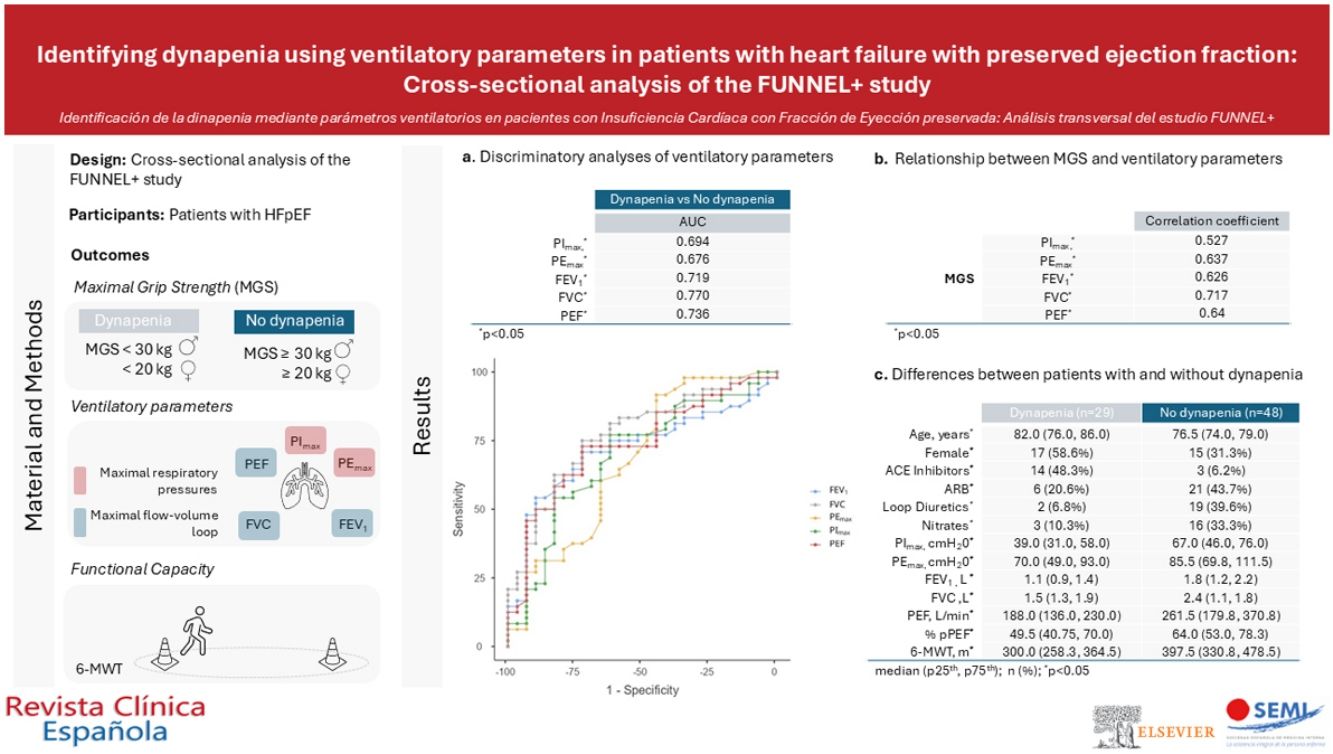
We aimed to evaluate: (a) the discriminatory capacity of ventilatory parameters to differentiate between patients with heart failure with preserved ejection fraction (HFpEF) with or without dynapenia, (b) the relationship between maximal grip strength (MGS) and ventilatory parameters, and (c) the differences between groups of HFpEF patients with and without dynapenia.

Materials and methods

A cross-sectional study using MGS and ventilatory parameters from volunteers in the FUNNEL+ study was conducted. Patients with HFpEF were categorised using the MGS into two groups: dynapenia and no dynapenia. Data analysis included the Chi-square test, the Wilcoxon signed-rank test, Spearman's correlation coefficient, the ROC curve analysis, and the area under the ROC curve.

Results

77 measurements of HFpEF patients were grouped based on the presence (n = 29) or no (n = 48) of dynapenia. The discriminatory capacity of forced expiratory volume in one second (FEV1), forced vital capacity (FVC), and peak expiratory flow (PEF) was acceptable for identifying dynapenia. Significant correlations were found between ventilatory parameters and MGS. Furthermore, significant differences were observed in grouped patients in terms of demographic, clinical and ventilatory variables.

Conclusions

These preliminary results suggest that ventilatory parameters may have potential for the early detection of dynapenia in HFpEF, although further studies are required to confirm these findings.

Keywords:
Heart failure
Preserved ejection fraction
Dynamometry
Spirometry
Maximal respiratory pressures
Discriminant capacity
Abbreviation:
ACE inhibitors
ARB
AUC
BMI
CKD
COPD
DM
DPP4
FEV1
FIV1
FIVC
FVC
GLP1
HF
HFpEF
LAD
LVD
LVH
MGS
mMRC
MRAs
NYHA
OSA
PAD
PAH
PEF
PEmax
PIF
PImax
SGT2I
Resumen
Introducción y objetivos

El objetivo de este estudio fue evaluar: (a) la capacidad discriminante de los parámetros ventilatorios para identificar pacientes con insuficiencia cardíaca con fracción de eyección preservada (IC-FEp) con o sin dinapenia, (b) la relación entre la fuerza de prensión máxima (FPM) y los parámetros ventilatorios, y (c) las diferencias entre los grupos de pacientes con IC-FEp con y sin dinapenia.

Material y método

Se realizó un estudio transversal utilizando la FPM y los parámetros ventilatorios de voluntarios del estudio FUNNEL+. Los pacientes con IC-FEp se clasificaron en dos grupos según la FPM: con dinapenia y sin dinapenia. El análisis de datos incluyó la prueba de Chi cuadrado, la prueba de rangos con signo de Wilcoxon, el coeficiente de correlación de Spearman, el análisis de la curva ROC y el área bajo la curva ROC.

Resultados

Se agruparon 77 mediciones de pacientes con IC-FEp en función de la presencia (n = 29) o ausencia (n = 48) de dinapenia. La capacidad discriminante del volumen espiratorio forzado en el primer segundo (FEV1), la capacidad vital forzada (FVC) y el flujo espiratorio máximo (PEF) fue aceptable para identificar dinapenia. Se encontraron correlaciones significativas entre los parámetros ventilatorios y la FPM. Además, se observaron diferencias significativas entre grupos en variables demográficas, clínicas y ventilatorias.

Conclusiones

Estos resultados preliminares apuntan al potencial de los parámetros ventilatorios para la detección temprana de la dinapenia en la IC-FEp, si bien se requieren estudios adicionales que los confirmen.
Palabras clave:
Insuficiencia cardíaca
Fracción de eyección preservada
Dinamometría
Espirometría
Presiones respiratorias máximas
Capacidad discriminatoria
Graphical abstract

Article

These are the options to access the full texts of the publication Revista Clínica Española (English Edition)
Member
Si es usted socio de FESEMI siga los siguientes pasos:

Diríjase desde aquí a la web de la >>>https://www.fesemi.org/publicaciones/revista-clinica/noticias<<< e inicie sesión mediante el formulario que se encuentra en la barra superior, pulsando sobre el candado.

Deslice el cursor hacia abajo hasta la sección "PUBLICACIONES" y pinche en "Revista Clínica Española":

>>>https://www.fesemi.org/publicaciones/revista-clinica/noticias<<<


Subscriber
Subscriber

If you already have your login data, please click here .

If you have forgotten your password you can you can recover it by clicking here and selecting the option “I have forgotten my password”
Subscribe
Subscribe to
Revista Clínica Española (English Edition)
Purchase
Purchase article

Purchasing article the PDF version will be downloaded

Purchase now
Contact
Phone for subscriptions and reporting of errors
From Monday to Friday from 9 a.m. to 6 p.m. (GMT + 1) except for the months of July and August which will be from 9 a.m. to 3 p.m.
Calls from Spain
932 415 960
Calls from outside Spain
+34 932 415 960
Email
References
[1]
B. Bozkurt, A.J.S. Coats, H. Tsutsui, et al.
Universal definition and classification of heart failure: a report of the Heart Failure Society of America, Heart Failure Association of the European Society of Cardiology, Japanese Heart Failure Society and Writing Committee of the Universal Definition of Heart Failure: Endorsed by the Canadian Heart Failure Society, Heart Failure Association of India, Cardiac Society of Australia and New Zealand, and Chinese Heart Failure Association.
Eur J Heart Fail, 23 (2021), pp. 352-380
[2]
P.A. Heidenreich, B. Bozkurt, D. Aguilar, et al.
2022 AHA/ACC/HFSA Guideline for the management of heart failure: a report of the American College of Cardiology/American Heart Association Joint Committee on Clinical Practice Guidelines.
Circulation, 145 (2022), pp. e895-e1032
[3]
K.M. Talha, A. Pandey, M. Fudim, et al.
Frailty and heart failure: state‐of‐the‐art review.
J Cachexia Sarcopenia Muscle, 14 (2023), pp. 1959-1972
[4]
T.A. McDonagh, M. Metra, M. Adamo, et al.
2021 ESC Guidelines for the diagnosis and treatment of acute and chronic heart failure.
Eur Heart J, 42 (2021), pp. 3599-3726
[5]
Y. Kinugasa, K. Yamamoto.
The challenge of frailty and sarcopenia in heart failure with preserved ejection fraction.
Heart Br Card Soc, 103 (2017), pp. 184-189
[6]
B.C. Clark, T.M. Manini.
What is dynapenia?.
Nutr Burbank Los Angel Cty Calif, 28 (2012), pp. 495-503
[7]
M. Konishi, N. Kagiyama, K. Kamiya, et al.
Impact of sarcopenia on prognosis in patients with heart failure with reduced and preserved ejection fraction.
Eur J Prev Cardiol, 28 (2021), pp. 1022-1029
[8]
A.J. Cruz-Jentoft, J.P. Baeyens, J.M. Bauer, et al.
Sarcopenia: European consensus on definition and diagnosis: report of the European Working Group on Sarcopenia in Older People.
Age Ageing, 39 (2010), pp. 412-423
[9]
K.M.K. Mansour, C.D.L. Goulart, L.C.S. de Carvalho-Junior, et al.
Pulmonary function and functional capacity cut-off point to establish sarcopenia and dynapenia in patients with COPD.
J Bras Pneumol Publicacao Of Soc Bras Pneumol E Tisilogia, 45 (2019),
[10]
R.B.S. Pedreira, M.H. Fernandes, T.A. Brito, P.A. Pinheiro, R.D.S. Coqueiro, J.A.O. Carneiro.
Are maximum respiratory pressures predictors of sarcopenia in the elderly?.
[11]
L.A. Soares, L.P. Lima, A.C.N. Prates, et al.
Accuracy of handgrip and respiratory muscle strength in identifying sarcopenia in older, community-dwelling, Brazilian women.
[12]
N. Mangner, E.B. Winzer, A. Linke, et al.
Locomotor and respiratory muscle abnormalities in HFrEF and HFpEF.
Front Cardiovasc Med, 10 (2023),
[13]
A.I. Cuesta-Vargas, I.J. Fuentes-Abolafio, C. García-Conejo, et al.
Effectiveness of a cardiac rehabilitation program on biomechanical, imaging, and physiological biomarkers in elderly patients with heart failure with preserved ejection fraction (HFpEF): FUNNEL + study protocol.
BMC Cardiovasc Disord, 23 (2023), pp. 550
[14]
V. Mathiowetz, L. Vizenor, D. Melander.
Comparison of baseline instruments to the jamar dynamometer and the B&L engineering pinch gauge.
Occup Ther J Res, 20 (2000), pp. 147-162
[15]
F. Lauretani, C.R. Russo, S. Bandinelli, et al.
Age-associated changes in skeletal muscles and their effect on mobility: an operational diagnosis of sarcopenia.
J Appl Physiol Bethesda Md 1985, 95 (2003), pp. 1851-1860
[16]
P. Laveneziana, A. Albuquerque, A. Aliverti, et al.
ERS statement on respiratory muscle testing at rest and during exercise.
[17]
Z. Dimitriadis, E. Kapreli, I. Konstantinidou, et al.
Test/retest reliability of maximum mouth pressure measurements with the MicroRPM in healthy volunteers.
Respir Care, 56 (2011), pp. 776-782
[18]
F. García-Río, M. Calle, F. Burgos, et al.
Spirometry. Spanish Society of Pulmonology and Thoracic Surgery (SEPAR).
Arch Bronconeumol, 49 (2013), pp. 388-401
[19]
B.L. Graham, I. Steenbruggen, M.R. Miller, et al.
Standardization of spirometry 2019 update. An Official American Thoracic Society and European Respiratory Society Technical Statement.
Am J Respir Crit Care Med, 200 (2019), pp. e70-e88
[20]
ATS Committee on Proficiency Standards for Clinical Pulmonary Function Laboratories.
ATS statement: guidelines for the six-minute walk test.
Am J Respir Crit Care Med, 166 (2002), pp. 111-117
[21]
(PDF) The Simple Difference Formula: An Approach to Teaching Nonparametric Correlation. ResearchGate 2024. https://doi.org/10.2466/11.IT.3.1.
[22]
Practical Nonparametric Statistics, 3rd Edition | Wiley n.d. https://www.wiley.com/en-us/Practical+Nonparametric+Statistics%2C+3rd+Edition-p-9780471160687 (Accessed 10 December 2024).
[23]
J.A. Swets.
Measuring the accuracy of diagnostic systems.
Science, 240 (1988), pp. 1285-1293
[24]
D.W. Hosmer Jr., S. Lemeshow.
Applied logistic regression.
John Wiley & Sons, (2004),
[25]
F. Faul, E. Erdfelder, A.-G. Lang, et al.
G*Power 3: a flexible statistical power analysis program for the social, behavioral, and biomedical sciences.
Behav Res Methods, 39 (2007), pp. 175-191
[26]
E.R. DeLong, D.M. DeLong, D.L. Clarke-Pearson.
Comparing the areas under two or more correlated receiver operating characteristic curves: a nonparametric approach.
Biometrics, 44 (1988), pp. 837-845
[27]
S. Lin, Y. Ma, H. Zou.
Enhanced Youden’s index with net benefit: a feasible approach for optimal-threshold determination in shared decision making.
J Eval Clin Pract, 26 (2020), pp. 551-558
[28]
W.-M. Huang, J.-Y. Feng, H.-M. Cheng, et al.
The role of pulmonary function in patients with heart failure and preserved ejection fraction: looking beyond chronic obstructive pulmonary disease.
[29]
J.R. Smith, E.H. Van Iterson, B.D. Johnson, et al.
Exercise ventilatory inefficiency in heart failure and chronic obstructive pulmonary disease.
Int J Cardiol, 274 (2019), pp. 232-236
[30]
K. Yamada, Y. Kinugasa, T. Sota, et al.
Inspiratory muscle weakness is associated with exercise intolerance in patients with heart failure with preserved ejection fraction: a preliminary study.
[31]
R.V. Shah, L.P. Cahalin, J.M. Haus, et al.
The role of maximal inspiratory pressure on functional performance in adults with heart failure.
ESC Heart Fail, 11 (2024), pp. 4231-4241
[32]
J.T. Walsh, R. Andrews, P. Johnson, et al.
Inspiratory muscle endurance in patients with chronic heart failure.
Heart Br Card Soc, 76 (1996), pp. 332-336
[33]
C.H. Martinez, A.A. Diaz, C.A. Meldrum, et al.
Handgrip strength in chronic obstructive pulmonary disease. Associations with acute exacerbations and body composition.
Ann Am Thorac Soc, 14 (2017), pp. 1638-1645
[34]
T. Tsuburai, Y. Komase, H. Tsuruoka, et al.
The relationship between peak inspiratory flow and hand grip strength measurement in men with mild chronic obstructive pulmonary disease.
BMC Pulm Med, 22 (2022), pp. 65
[35]
Y. Lee, S. Son, D.-K. Kim, et al.
Association of diaphragm thickness and respiratory muscle strength with indices of sarcopenia.
Ann Rehabil Med, 47 (2023), pp. 307-314
[36]
S.M. Ratchford, H.L. Clifton, D.T. La Salle, et al.
Cardiovascular responses to rhythmic handgrip exercise in heart failure with preserved ejection fraction.
J Appl Physiol Bethesda Md 1985, 129 (2020), pp. 1267-1276
[37]
N. Villarraga, B. Warner, E.J. Bruhn, et al.
Higher work of breathing during exercise in heart failure with preserved ejection fraction.
Chest, 163 (2023), pp. 1492-1505
[38]
R. Andrea, A. López-Giraldo, C. Falces, et al.
Lung function abnormalities are highly frequent in patients with heart failure and preserved ejection fraction.
Heart Lung Circ, 23 (2014), pp. 273-279
[39]
L.D.N. Pereira, M.S. Pegorari, L.J. Patrizzi, et al.
Cross-sectional study on the association between respiratory muscle strength and dynapenic abdominal obesity in Community-dwelling older adults.
Clin Interv Aging, 18 (2023), pp. 1351-1359
[40]
J. Spiesshoefer, C. Henke, H.J. Kabitz, et al.
Heart failure results in inspiratory muscle dysfunction irrespective of left ventricular ejection fraction.
Respiration, 100 (2020), pp. 96-108
[41]
D.G. Ohara, Y.P. Moreira, C.F.R. Silva, et al.
Impaired pulmonary function is associated with dynapenia, but not with abdominal obesity and dynapenic abdominal obesity in older adults.
Eur Geriatr Med, 13 (2022), pp. 475-482
[42]
M. Aubertin-Leheudre, S. Anton, D. Beavers, et al.
Dynapenia and metabolic health in obese and non-obese older adults aged 70 years and older: the life study.
J Am Med Dir Assoc, 18 (2017), pp. 312-319
[43]
D. Shuaishuai, L. Jingyi, Z. Zhiqiang, et al.
Sex differences and related estrogenic effects in heart failure with preserved ejection fraction.
Heart Fail Rev, 28 (2023), pp. 937-948
[44]
Y. Smereka, J.A. Ezekowitz.
HFpEF and sex: understanding the role of sex differences.
Can J Physiol Pharmacol, 102 (2024), pp. 465-475
[45]
M. Saitoh, N. Ebner, S. von Haehling, et al.
Therapeutic considerations of sarcopenia in heart failure patients.
Expert Rev Cardiovasc Ther, 16 (2018), pp. 133-142
[46]
H. Fukuta, T. Goto, K. Wakami, et al.
Effect of renin-angiotensin system inhibition on cardiac structure and function and exercise capacity in heart failure with preserved ejection fraction: a meta-analysis of randomized controlled trials.
Heart Fail Rev, 26 (2021), pp. 1477-1484
[47]
N.D. Karakousis, P.N. Georgakopoulos.
Loop diuretics and sarcopenia: a potential association.
Muscles Basel Switz, 2 (2023), pp. 317-326
[48]
C. Okoye, T. Mazzarone, C. Cargiolli, et al.
Discontinuation of loop diuretics in older patients with chronic stable heart failure: a narrative review.
Drugs Aging, 40 (2023), pp. 981-990
Idiomas
Revista Clínica Española (English Edition)
Article options
Tools
Supplemental materials
