
Suggestions
Idioma
Guide for authors
Searcher
Journal Information
Cite
Cite
Share
Download PDF
More article options
Visits
100
Original article
Uncorrected Proof. Available online 4 November 2026

Cardiometabolic abnormalities among normal-weight adults: Prevalence and associated sociodemographic and lifestyle factors in a large Spanish cohort

Alteraciones cardiometabólicas en adultos con peso normal: prevalencia y factores sociodemográficos y de estilo de vida asociados en una gran cohorte española
Visits
100
P. Riutord-Sbert, J.I. Ramírez-Manent, P.J. Tarraga López
Corresponding author
pjtarraga@sescam.jccm.es

Corresponding author.
, C. Busquets-Cortes, I.C. campayo, Á.A. López-González
Universidad de Castilla-La Mancha - Campus de Albacete, Almansa 14, 02005 Albacete, Albacete, Spain
This item has received
Article information
Abstract
Full Text
Bibliography
Download PDF
Statistics
Abstract
Background

Although body mass index (BMI) is widely used to assess obesity-related health risks, it may fail to detect individuals with normal weight who present with significant cardiometabolic abnormalities. This phenotype, often overlooked in clinical practice, is associated with increased risk of cardiovascular disease and type 2 diabetes. Objective: To assess the prevalence and determinants of cardiometabolic abnormalities in a large cohort of Spanish adults with normal BMI and to explore their associations with sociodemographic and lifestyle variables.

Methods

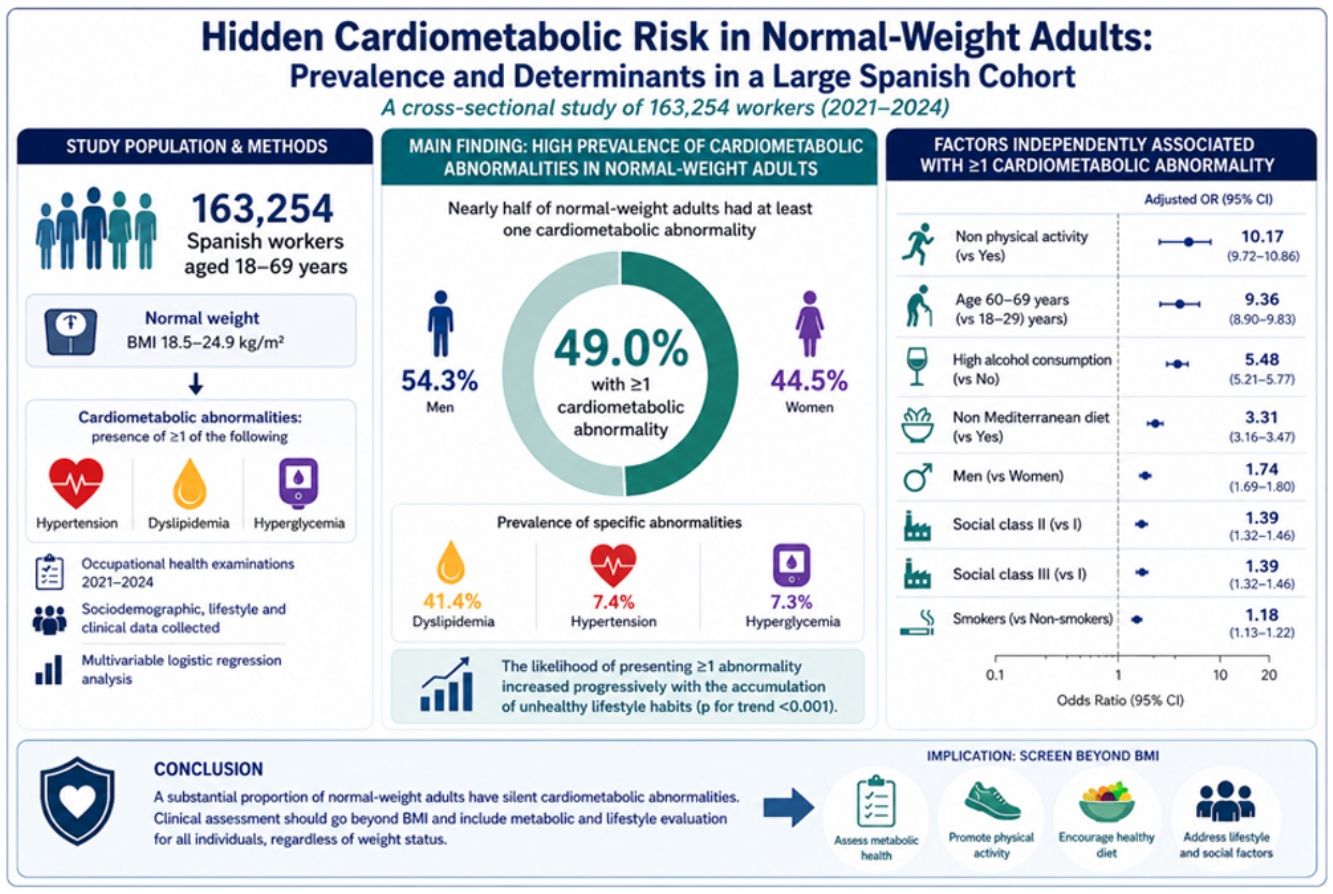
This cross-sectional study included 163,254 workers aged 18–69 years who underwent occupational health examinations between 2021 and 2024. Only individuals with a BMI between 18.5 and 24.9 kg/m² were included. Cardiometabolic abnormalities were defined as the presence of hypertension, dyslipidemia, or hyperglycemia. Sociodemographic data, smoking status, alcohol intake (measured in standard drinking units), physical activity (assessed with the IPAQ), and Mediterranean diet adherence (assessed using the MEDAS-14 questionnaire) were collected. Multivariate logistic regression analyses were performed to identify factors associated with the presence of one or more cardiometabolic abnormalities.

Results

Among normal-weight adults, 49.0% presented at least one cardiometabolic abnormality. The prevalence was higher in men (54.3%) than in women (44.5%). Cardiometabolic risk was significantly higher among men, older individuals, smokers, those with low physical activity, poor adherence to the Mediterranean diet, and high alcohol consumption. Lower occupational social class was also associated with greater risk. The likelihood of presenting ≥1 cardiometabolic abnormality increased progressively with the accumulation of unhealthy lifestyle habits.

Conclusions

A substantial proportion of normal-weight individuals exhibit cardiometabolic abnormalities, underscoring the need to move beyond BMI in clinical risk stratification. Preventive strategies should incorporate metabolic screening and lifestyle assessments for all individuals, regardless of weight status, to identify those at silent cardiometabolic risk.

Keywords:
Normal-weight
Arterial hypertension
Dyslipidemia
Hyperglycemia
Lifestyle
Sociodemographic variables
Resumen
Introducción

Aunque el índice de masa corporal (IMC) se utiliza ampliamente para evaluar los riesgos para la salud relacionados con la obesidad, puede no detectar a individuos con peso normal que presentan alteraciones cardiometabólicas significativas. Este fenotipo, a menudo pasado por alto en la práctica clínica, se asocia con un mayor riesgo de enfermedad cardiovascular y diabetes tipo 2.

Objetivo

Evaluar la prevalencia y los determinantes de las alteraciones cardiometabólicas en una amplia cohorte de adultos con IMC normal y explorar su asociación con variables sociodemográficas y de estilo de vida.

Métodos

Este estudio transversal incluyó a 163.254 trabajadores de entre 18 y 69 años que se sometieron a exámenes de salud laboral entre 2021 y 2024. Solo se incluyeron individuos con un IMC entre 18,5 y 24,9 kg/m². Las alteraciones cardiometabólicas se definieron como la presencia de hipertensión, dislipidemia o hiperglucemia. Se recogieron datos sociodemográficos, hábito tabáquico, consumo de alcohol (medido en unidades estándar), actividad física (evaluada mediante el IPAQ) y adherencia a la dieta mediterránea (evaluada mediante el cuestionario MEDAS-14). Se realizaron análisis de regresión logística multivariable para identificar los factores asociados a la presencia de una o más alteraciones cardiometabólicas.

Resultados

Entre los adultos con peso normal, el 49,0% presentó al menos una alteración cardiometabólica. La prevalencia fue mayor en hombres (54,3%) que en mujeres (44,5%). El riesgo cardiometabólico fue significativamente mayor en hombres, personas de mayor edad, fumadores, individuos con baja actividad física, baja adherencia a la dieta mediterránea y alto consumo de alcohol. Una menor clase social ocupacional también se asoció con un mayor riesgo. La probabilidad de presentar ≥1 alteración cardiometabólica aumentó progresivamente con la acumulación de hábitos de vida no saludables.

Conclusiones

Una proporción considerable de individuos con peso normal presenta alteraciones cardiometabólicas, lo que pone de manifiesto la necesidad de ir más allá del IMC en la estratificación del riesgo clínico. Las estrategias preventivas deberían incorporar la evaluación metabólica y del estilo de vida en todos los individuos, independientemente de su peso, con el fin de identificar a aquellos con riesgo cardiometabólico silencioso.
Palabras clave:
Peso normal
Hipertensión arterial
Dislipidemia
Hiperglucemia
Estilo de vida
Variables sociodemográficas
Graphical abstract

Article

These are the options to access the full texts of the publication Revista Clínica Española (English Edition)
Member
Si es usted socio de FESEMI siga los siguientes pasos:

Diríjase desde aquí a la web de la >>>https://www.fesemi.org/publicaciones/revista-clinica/noticias<<< e inicie sesión mediante el formulario que se encuentra en la barra superior, pulsando sobre el candado.

Deslice el cursor hacia abajo hasta la sección "PUBLICACIONES" y pinche en "Revista Clínica Española":

>>>https://www.fesemi.org/publicaciones/revista-clinica/noticias<<<


Subscriber
Subscriber

If you already have your login data, please click here .

If you have forgotten your password you can you can recover it by clicking here and selecting the option “I have forgotten my password”
Subscribe
Subscribe to
Revista Clínica Española (English Edition)
Purchase
Purchase article

Purchasing article the PDF version will be downloaded

Purchase now
Contact
Phone for subscriptions and reporting of errors
From Monday to Friday from 9 a.m. to 6 p.m. (GMT + 1) except for the months of July and August which will be from 9 a.m. to 3 p.m.
Calls from Spain
932 415 960
Calls from outside Spain
+34 932 415 960
Email
References
[1]
World Health Organization.
[2]
C.E. Hagberg, K.L. Spalding.
White adipocyte dysfunction and obesity-associated pathologies in humans.
Nat Rev Mol Cell Biol, 25 (2024), pp. 270-289
[3]
T. Kawai, M.V. Autieri, R. Scalia.
Adipose tissue inflammation and metabolic dysfunction in obesity.
Am J Physiol Cell Physiol, 320 (2021), pp. C375-C391
[4]
X. Cheng, S. Jiang, B. Pan, W. Xie, J. Meng.
Ectopic and visceral fat deposition in aging, obesity, and idiopathic pulmonary fibrosis: an interconnected role.
Lipids Health Dis, 22 (2023), pp. 201
[5]
A. Guo, K. Li, H.C. Tian, et al.
FGF19 protects skeletal muscle against obesity-induced muscle atrophy, metabolic derangement and abnormal irisin levels via the AMPK/SIRT-1/PGC-α pathway.
J Cell Mol Med, 25 (2021), pp. 3585-3600
[6]
K. Sweatt, W.T. Garvey, C. Martins.
Strengths and limitations of BMI in the diagnosis of obesity: what is the path forward?.
Curr Obes Rep, 13 (2024), pp. 584-595
[7]
L. Salmón-Gómez, V. Catalán, G. Frühbeck, J. Gómez-Ambrosi.
Relevance of body composition in phenotyping the obesities.
Rev Endocr Metab Disord, 24 (2023), pp. 809-823
[8]
F. Rubino, D.E. Cummings, R.H. Eckel, et al.
Definition and diagnostic criteria of clinical obesity.
Lancet Diabetes Endocrinol, 13 (2025), pp. 221-262
[9]
M.W. Seo, J.Y. Kim.
Metabolically unhealthy phenotype in adults with normal weight: Is cardiometabolic health worse off when compared to adults with obesity?.
Obes Res Clin Pract, 17 (2023), pp. 116-121
[10]
W. Perini, A.E. Kunst, M.B. Snijder, R.J.G. Peters, I.G.M. van Valkengoed.
Ethnic differences in metabolic cardiovascular risk among normal weight individuals: Implications for cardiovascular risk screening. The HELIUS study.
Nutr Metab Cardiovasc Dis, 29 (2019), pp. 15-22
[11]
P. Zhong, S. Tan, Z. Zhu, et al.
Normal-weight central obesity and risk of cardiovascular and microvascular events in adults with prediabetes or diabetes: Chinese and British cohorts.
Diabetes Metab Res Rev, 39 (2023),
[12]
N. Mohammadian Khonsari, P. Khashayar, E. Shahrestanaki, et al.
Normal weight obesity and cardiometabolic risk factors: a systematic review and meta-analysis.
Front Endocrinol (Lausanne), 13 (2022),
[13]
P. Morigny, J. Boucher, P. Arner, D. Langin.
Lipid and glucose metabolism in white adipocytes: pathways, dysfunction and therapeutics.
Nat Rev Endocrinol, 17 (2021), pp. 276-295
[14]
N.K. Adjei, F. Samkange-Zeeb, D. Boakye, et al.
Ethnic differences in metabolic syndrome in high-income countries: a systematic review and meta-analysis.
Rev Endocr Metab Disord, 25 (2024), pp. 727-750
[15]
N.N. Wijayatunga, E.J. Dhurandhar.
Normal weight obesity and unaddressed cardiometabolic health risk-a narrative review.
Int J Obes (Lond), 45 (2021), pp. 2141-2155
[16]
M. Wang, K. Xu, J. Yang, D.A. Bennett, H. Du, X. Liu.
Normal-weight obesity subtypes and 10-year risks of major vascular diseases in 0.3 million adults.
Clin Nutr, 45 (2025), pp. 36-42
[17]
B.A. Jané, J.I. Ramírez-Manent, S.A. Bote, P.R. Sbert, H.M. González San Mıguel, ÁA. Lopez González.
Determination of cardiovascular risk in 192,711 underweight and normal weight workers.
Turk J Med Sci, 52 (2022), pp. 926-933
[18]
T. Sastre-Alzamora, P. Tomás-Gil, H. Paublini, L. Pallarés, J.I. Ramírez-Manent, A.A. López-González.
Relationship between different scales of overweight and obesity and heart age values in 139634 spanish workers.
Acad J Health Sci, 38 (2023), pp. 137-144
[19]
M.A. Martínez-González, P. Montero, M. Ruiz-Canela, et al.
Yearly attained adherence to Mediterranean diet and incidence of diabetes in a large randomized trial.
Cardiovasc Diabetol, 22 (2023), pp. 262
[20]
M. Mestre-Font, C. Busquets-Cortés, J.I. Ramírez-Manent, P. Tomás-Gil, H. Paublini, A.A. López-González.
Influence of sociodemographic variables and healthy habits on the values of overweight and obesity scales in 386,924 Spanish workers.
Acad J Health Sci, 39 (2024), pp. 27-35
[21]
V. Sember, K. Meh, M. Sorić, G. Starc, P. Rocha, G. Jurak.
Validity and reliability of international physical activity questionnaires for adults across EU countries: systematic review and meta analysis.
Int J Environ Res Public Health, 17 (2020),
[22]
M. Mestre Font, C. Busquets-Cortés, J.I. Ramírez-Manent, D. Vallejos, T. Sastre Alzamora, A.A. López-González.
Influence of sociodemographic variables and healthy habits on the values of cardiometabolic risk scales in 386924 spanish workers.
Acad J Health Sci, 39 (2024), pp. 112-121
[23]
J. Obrador de Hevia, ÁA. López-González, J.I. Ramírez-Manent, H. Paublini Oliveira, P.J. Tárraga López, P. Riutord-Sbert.
Relationship between alcohol consumption and other variables with the values of different cardiovascular risk factors in 139634 Spanish workers.
Acad J Health Sci, 39 (2024), pp. 132-141
[24]
J.B. Meigs, P.W. Wilson, C.S. Fox, et al.
Body mass index, metabolic syndrome, and risk of type 2 diabetes or cardiovascular disease.
J Clin Endocrinol Metab, 91 (2006), pp. 2906-2912
[25]
P.T. Bradshaw, K.L. Monda, J. Stevens.
Metabolic syndrome in healthy obese, overweight, and normal weight individuals: the Atherosclerosis Risk in Communities Study.
Obesity (Silver Spring), 21 (2013), pp. 203-209
[26]
S. Gómez-Zorita, M. Queralt, M.A. Vicente, M. González, M.P. Portillo.
Metabolically healthy obesity and metabolically obese normal weight: a review.
J Physiol Biochem, 77 (2021), pp. 175-189
[27]
R.M. Manapurath, R. Hadaye, B. Gadapani.
Normal weight obesity: role of apoB and insulin sensitivity in predicting future cardiovascular risk.
Int J Prev Med, 13 (2022), pp. 31
[28]
R.P. Wildman, P. Muntner, K. Reynolds, et al.
The obese without cardiometabolic risk factor clustering and the normal weight with cardiometabolic risk factor clustering: prevalence and correlates of 2 phenotypes among the US population (NHANES 1999-2004).
Arch Intern Med, 168 (2008), pp. 1617-1624
[29]
J. Arnlöv, E. Ingelsson, J. Sundström, L. Lind.
Impact of body mass index and the metabolic syndrome on the risk of cardiovascular disease and death in middle-aged men.
Circulation, 121 (2010), pp. 230-236
[30]
A. Romero-Corral, V.K. Somers, J. Sierra-Johnson, et al.
Normal weight obesity: a risk factor for cardiometabolic dysregulation and cardiovascular mortality.
Eur Heart J, 31 (2010), pp. 737-746
[31]
J.P. Rey-López, L.F. de Rezende, M. Pastor-Valero, B.H. Tess.
The prevalence of metabolically healthy obesity: a systematic review and critical evaluation of the definitions used.
Obes Rev, 15 (2014), pp. 781-790
[32]
N. Stefan, F. Schick, H.U. Häring.
Causes, characteristics, and consequences of metabolically unhealthy normal weight in humans.
Cell Metab, 26 (2017), pp. 292-300
Idiomas
Revista Clínica Española (English Edition)
Article options
Tools
