

Suggestions
Idioma
Guide for authors
Searcher
Journal Information
Vol. 226. Issue 2.
(February 2026)
Cite
Cite
Share
Download PDF
More article options
Visits
1051
Vol. 226. Issue 2.
(February 2026)
Original Breve

Análisis de los problemas sociales para el alta en hospitalización de agudos

Analysis of social problems for discharge in acute care hospitalization
Visits
1051
A. Jiménez-Puentea,e,f,
Corresponding author
, M.D. Martín-Escalanteb,e,f, M. Noureddine-Lópezb,e, F. Rivas-Ruizc,e,f, A. Rubio-Gallod,g
a Unidad de Evaluación, Hospital Universitario Costa del Sol, Marbella, Málaga, España
b Área de Medicina Interna, Hospital Universitario Costa del Sol, Marbella, Málaga, España
c Unidad de Investigación e Innovación, Hospital Universitario Costa del Sol, Marbella, Málaga, España
d Unidad de Trabajo Social, Hospital Universitario Costa del Sol, Marbella, Málaga, España
e IBIMA Plataforma BIONAND, Málaga, España
f Red de Investigación en Cronicidad, Atención Primaria y Promoción de la Salud (RICAPPS), España
g Facultad de Estudios Sociales y del Trabajo, Universidad de Málaga, Málaga, España
This item has received
Article information
Abstract
Full Text
Bibliography
Download PDF
Statistics
Resumen
Introducción

Los pacientes que permanecen hospitalizados por no disponer de un entorno social adecuado para el alta constituyen un problema creciente en una sociedad en progresivo envejecimiento y cuyas redes de cuidados dentro de la familia se han debilitado.

Material y métodos

Estudio realizado en un hospital de agudos del sur de España sobre pacientes hospitalizados con interconsulta a Trabajo Social en la que se especificó que existían problemas sociales para el alta (PSA). Se analizó el histórico desde 2006, además de dos periodos de 24meses, anterior y posterior a la pandemia COVID-19.

Resultados

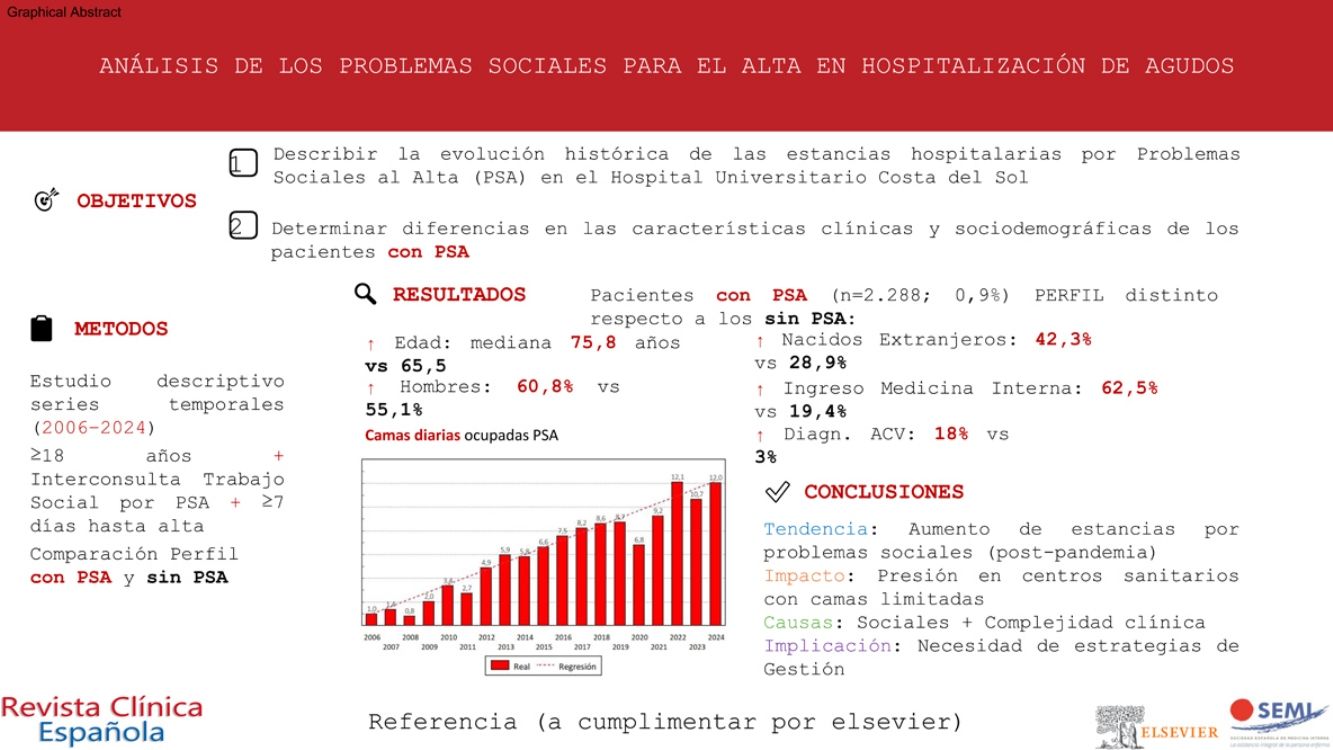
Se analizaron 2.288 altas con PSA. Entre 2006 y 2024 se produjo un aumento medio anual de 0,62 camas por día ocupadas por pacientes con PSA, especialmente en 2022 y 2024, cuando el 1,3% de las altas hospitalarias se vieron retrasadas por PSA, lo que equivale a 11camas diarias ocupadas. Medicina Interna fue la especialidad con más pacientes con PSA: 4%.

Conclusiones

Las estancias debidas a PSA suponen un volumen importante y muestran una tendencia ascendente. Las causas son multifactoriales e incluyen principalmente circunstancias sociales y de complejidad clínica de los pacientes.

Palabras clave:
Altas diferidas
Ocupación de camas
Problemas sociales
Abstract
Introduction

Patients who remain hospitalized due to the absence of adequate social support for discharge represent a growing challenge in an aging society where traditional family care networks are increasingly weakened.

Methods

We conducted a study in an acute care hospital in southern Spain, focusing on inpatients referred to the Social Work Department in whom social problems were identified as barriers to discharge (SPD). Data were reviewed from 2006 onwards, as well as across two 24-month periods: before and after the COVID-19 pandemic.

Results

2288 discharges with SPD were analyzed. From 2006 to 2024, the number of beds occupied by patients with SPD increased by an average of 0.62beds per day each year. The rise was particularly marked in 2022 and 2024, when 1.3% of all hospital discharges were delayed due to SPD, equivalent to 11beds occupied daily. Internal Medicine was the specialty with the highest proportion of patients with SPD: 4%.

Conclusions

Hospital stays prolonged by social problems represent a substantial burden and show a clear upward trend. The underlying causes are multifactorial, mainly related to social circumstances and the clinical complexity of patients.
Keywords:
Delayed discharge
Bed occupancy
Social problems
Graphical abstract

Article

These are the options to access the full texts of the publication Revista Clínica Española (English Edition)
Member
Si es usted socio de FESEMI siga los siguientes pasos:

Diríjase desde aquí a la web de la >>>https://www.fesemi.org/publicaciones/revista-clinica/noticias<<< e inicie sesión mediante el formulario que se encuentra en la barra superior, pulsando sobre el candado.

Deslice el cursor hacia abajo hasta la sección "PUBLICACIONES" y pinche en "Revista Clínica Española":

>>>https://www.fesemi.org/publicaciones/revista-clinica/noticias<<<


Subscriber
Subscriber

If you already have your login data, please click here .

If you have forgotten your password you can you can recover it by clicking here and selecting the option “I have forgotten my password”
Subscribe
Subscribe to
Revista Clínica Española (English Edition)
Purchase
Purchase article

Purchasing article the PDF version will be downloaded

Purchase now
Contact
Phone for subscriptions and reporting of errors
From Monday to Friday from 9 a.m. to 6 p.m. (GMT + 1) except for the months of July and August which will be from 9 a.m. to 3 p.m.
Calls from Spain
932 415 960
Calls from outside Spain
+34 932 415 960
Email
Bibliografía
[1]
World Health Organization.
World Report on Ageing and Health..
World Health Organization;, (2015),
[2]
A. Micallef, S.C. Buttigieg, G. Tomaselli, L. Garg.
Defining delayed discharges of inpatients and their impact in acute hospital care: a scoping review.
Int J Health Policy Manag., 11 (2022), pp. 103-111
[3]
N. López-Luis, C. Rodríguez-Álvarez, L. Cuéllar-Pompa, A. Arias.
Evaluation of delayed effective discharge for non-medical reasons in patients admitted to acute care hospitals in Spain: a scoping review.
Nurs Rep., 14 (2023), pp. 12-24
[4]
A. Pellico-López, D. Cantarero, A. Fernández-Feito, P. Parás-Bravo, J. Cayón de las Cuevas, M. Paz-Zulueta.
Factors associated with bed-blocking at a university hospital (Cantabria, Spain) between 2007 and 2015: a retrospective observational study.
Int J Environ Res Public Health., 16 (2019),
[5]
D. Mendoza-Giraldo, A. Navarro, A. Sánchez-Quijano, A. Villegas, R. Asencio, E. Lissen.
Retraso del alta hospitalaria por motivos no médicos.
Rev Clin Esp., 212 (2012), pp. 229-234
[6]
A. Pellico-López, A. Fernández-Feito, D. Cantarero, et al.
Cost of stay and characteristics of patients with stroke and delayed discharge for non-clinical reasons.
[7]
S. Fernández-García, C. Represas-Represas, A. Ruano-Raviña, et al.
Predictores sociales y clínicos asociados con estancia hospitalaria prolongada en pacientes con agudización grave de EPOC.
Rev Clin Esp., 220 (2020), pp. 79-85
[8]
Defensor del Pueblo. El Defensor del Pueblo se interesa por los pacientes que no tienen dónde ir al recibir el alta hospitalaria [consultado 29 Jul 2025]. Disponible en: https://www.defensordelpueblo.es/noticias/actuacion-oficio-conocer-protocolos-se-aplican/
[9]
Instituto de Estadística y Cartografía de Andalucía. Sistema de Información Multiterritorial de Andalucía (SIMA) [consultado 6 Oct 2025]. Disponible en: https://www.ieca.junta-andalucia.es/institutodeestadisticaycartografia/dega/sistema-de-informacion-multiterritorial-de-andalucia-sima
[10]
Instituto Nacional de Estadística. Estadística Continua de Población (ECP) [consultado 6 Oct 2025]. Disponible en: https://www.ine.es/dyngs/Prensa/ECP2T25.htm
[11]
E. Ceriani, O. Milani, M. Donadoni, et al.
COmplexity of CARE and Discharge barriers: the ‘modern internal medicine patient’. Results from the CO-CARED study.
[12]
M. Martins, A. Mesquita, L. Carvalho, et al.
Risk factors for delayed discharge due to social factors: a retrospective study.
Acta Med Port., 36 (2023), pp. 550-558
[13]
A.D. Bai, C. Dai, S. Srivastava, C.A. Smith, S.S. Gill.
Risk factors, costs and complications of delayed hospital discharge from internal medicine wards at a Canadian academic medical centre: retrospective cohort study.
BMC Health Serv Res., 19 (2019), pp. 935
[14]
L.P. Gallardo-Peralta, E. Sánchez-Moreno, V.R. Rodríguez, M.G. Martín.
La investigación sobre soledad y redes de apoyo social en las personas mayores: una revisión sistemática en Europa.
Rev Esp Salud Publica., 97 (2023), pp. e202301006
[15]
European Anti-Poverty Network (EAPN). Informe Arope 2025. Las Comunidades Autónomas [consultado 29 Jul 2025]. Disponible en: https://www.eapn.es/estadodepobreza/descargas.php
[16]
Aceituno Nieto P, Ramiro Fariñas D, Castillo Belmonte AB, Escudero Martínez J. Estadísticas sobre residencias: distribución de centros y plazas residenciales por provincia. Datos de septiembre de 2022. Madrid, Informes Envejecimiento en red n.° 31, 20p; fecha de publicación: 31 Oct 2023 [consultado 29 Jul 2025]. Disponible en: https://envejecimientoenred.csic.es/
[17]
G. Spiers, F.E. Matthews, S. Moffatt, et al.
Impact of social care supply on healthcare utilisation by older adults: a systematic review and meta-analysis.
Age Ageing., 48 (2019), pp. 57-66
[18]
F. Rivas-Ruiz, M. Padilla-Ruiz, A. Pérez-Aisa, J. Peláez-Cherino, A. Lara-Blanquer, A. Jiménez Puente.
Urgencias hospitalarias por consumo de alcohol en tiempos de la COVID-19 en la Costa del Sol.
Rev Esp Salud Publica., 98 (2024), pp. e202402004
Idiomas
Revista Clínica Española (English Edition)
Article options
Tools
